# Amazon deforestation has removed an area of forest the size of Germany and France, researchers say
Event date: 2024-09-23
Researchers say the Amazon rainforest has lost an area roughly equal to Germany and France combined to deforestation over four decades, a scale of forest loss that is now feeding drought and record wildfires across South America.
The packet attributes the estimate to RAISG, a collective of researchers and NGOs that tracked changes from 1985 to 2023. Its figures show that 12.5% of the Amazon’s plant cover has disappeared over that period, equal to about 88 million hectares across the nine-country Amazon basin.
That is a vast ecological change by any measure. The Amazon is not just a collection of trees; it is a climate system, a water pump and a carbon sink. When large areas are cleared for mining, cattle, soy and other uses, the consequences can spread well beyond the sites where the trees were cut down.
The report says the loss has contributed to hotter, drier conditions and to the spread of fires. Copernicus said the Amazon and Pantanal fires were the worst in nearly two decades, while climate attribution researchers said warming was increasing the risk and severity of the blazes. The packet also notes that the drought has pushed some Amazon rivers to their lowest levels in decades, affecting the lives of roughly 47 million people who live along them.
The source is careful to connect the dots without overclaiming. It says deforestation has left more land as pasture, soy fields, monocultures and mining pits, and that this has disrupted the hydrological cycle and increased carbon emissions. It does not claim every fire is caused solely by deforestation, but it does present forest loss as a major driver of the current emergency.
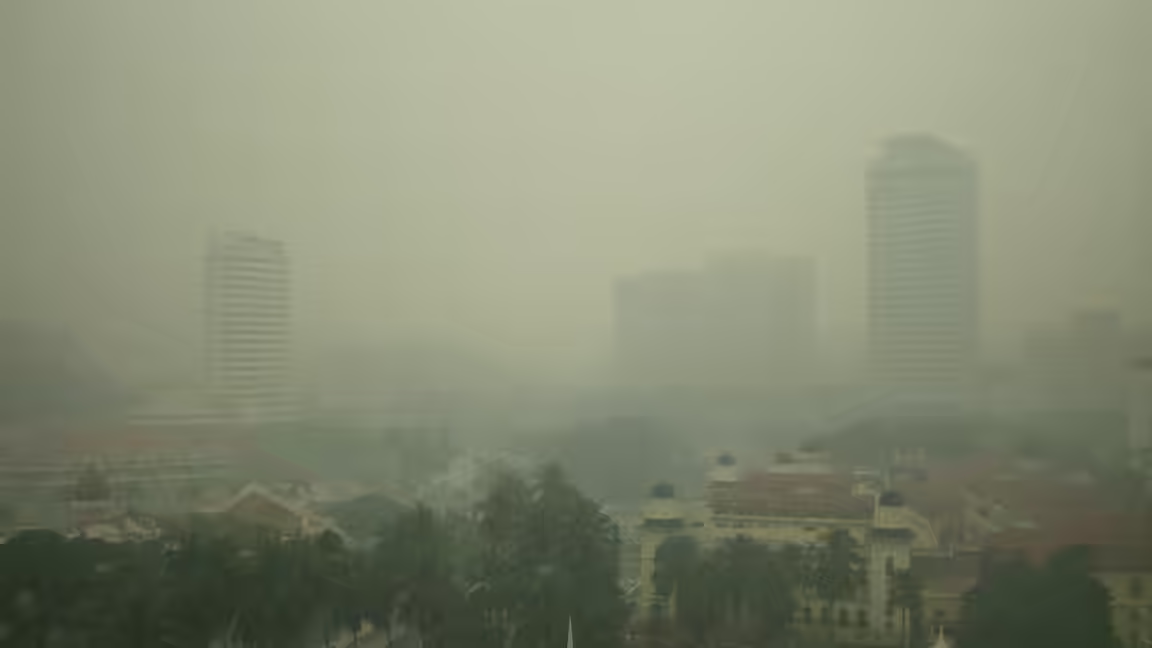
The human cost is not abstract. The excerpt says smoke has choked cities such as Brasilia, Rio de Janeiro and Sao Paulo, while neighboring countries have also felt the effects. Ecuador is facing energy shortages linked to its worst drought in six decades, and several South American governments have had to respond to fire and water stress at once.
The report also highlights a policy problem. Some countries, including Brazil, have slowed deforestation, but others have cut environmental budgets or weakened institutions. The implication is that the Amazon crisis is not just ecological but political, shaped by state capacity, land use and enforcement.
What the evidence supports most clearly is the scale of loss: 88 million hectares, or an area the size of Germany and France combined. That figure gives a concrete shape to a crisis that is often described in the abstract. It also helps explain why Amazon fires are now treated as a global climate and biodiversity issue, not merely a regional environmental story.