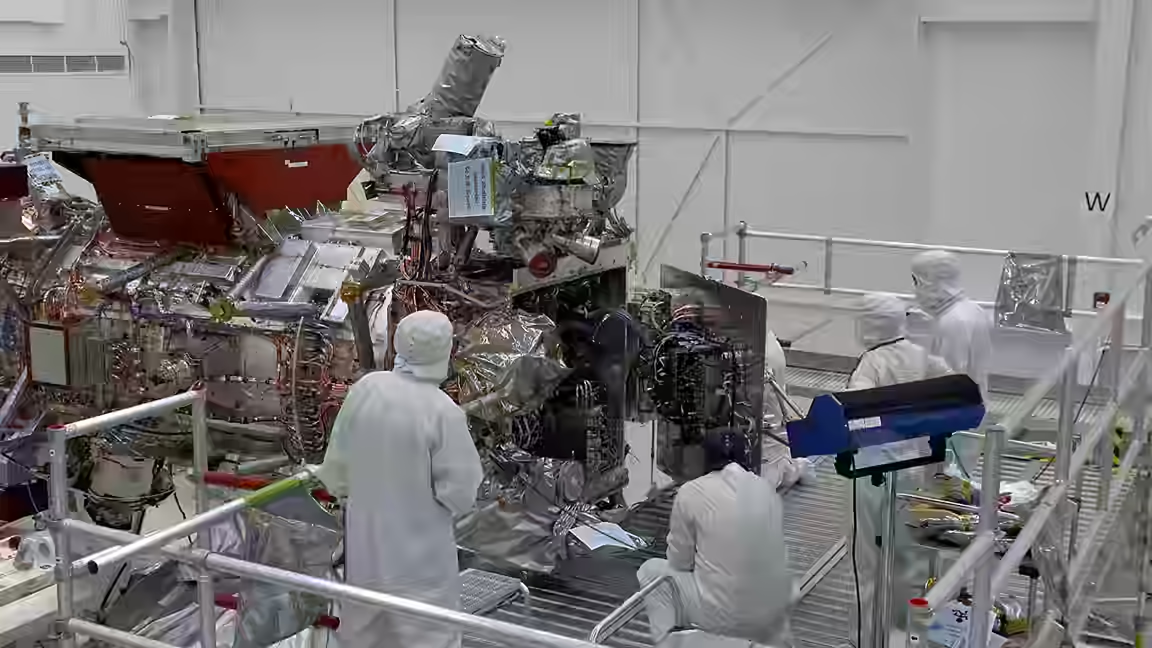
A SpaceX Falcon 9 launched the European Space Agency's Hera spacecraft from Cape Canaveral Space Force Station, placing it on an interplanetary trajectory toward a binary asteroid system. Liftoff occurred at 10:52 a.m. Eastern time, and the rocket's upper stage deployed Hera about 76 minutes later after two burns.
ESA project manager Ian Carnelli said the spacecraft was communicating with controllers and performing as expected during initial checks. Teams planned to test its systems and take an image of Earth and the Moon. A manoeuvre later in October was due to prepare Hera for a Mars flyby in March 2025, before arrival at Didymos and its moon Dimorphos in late 2026.
The launch proceeded despite rain and thick cloud after a forecast had placed the chance of acceptable conditions at only 15%. Weather improved during the morning. It was also the first Falcon 9 mission after an anomaly during a post-deployment deorbit burn on the Crew-9 flight on September 28. The US Federal Aviation Administration permitted Hera's launch because its upper stage was headed out of Earth orbit and required no comparable deorbit burn.
SpaceX did not recover the first-stage booster, B1061. Hera's interplanetary trajectory demanded extra performance, so the stage was expended on its 23rd and final flight. Its earlier missions included Crew-1, Crew-2, a cargo flight to the International Space Station and 10 Starlink launches.
Hera will revisit the scene of NASA's 2022 Double Asteroid Redirection Test. DART deliberately struck Dimorphos and shortened its orbit around Didymos, demonstrating that a kinetic impact could alter an asteroid's motion. Hera's 12 instruments will measure the aftermath, including the shape and structure of Dimorphos, so researchers can compare the real outcome with impact models and better judge the technique's usefulness for planetary defence.
The 1,081-kilogram spacecraft also carries two six-unit CubeSats. Juventas will use radar to probe the asteroids' interiors and determine whether they are loose collections of smaller rocks. Milani will study surface material and composition. Both small spacecraft are expected to attempt landings on Dimorphos, and Juventas carries a gravimeter for measuring its weak gravitational field. Hera itself may finish with a landing on Didymos.
ESA put the mission's cost at €363 million, or about $401 million, after funding was approved in late 2019. The launch completed only the opening phase. Years of cruise, navigation and commissioning remained before Hera could supply the close-up measurements needed to explain precisely how DART changed Dimorphos. Mission scientists expected the close study to test competing models rather than merely repeat the orbital change already measured after the impact.

