South Korean President Yoon Suk Yeol declared martial law in a nationally televised address late on December 3, setting off a confrontation at parliament that ended with lawmakers voting to block the measure within hours.
KBS reported that Yoon announced a state of emergency and imposed martial law on Tuesday night. He accused the political opposition of anti-state activity. In the address, according to the BBC, Yoon said the measure was necessary to protect the country from North Korean communist forces and eliminate what he called anti-state elements.
The declaration immediately disrupted the National Assembly. Police arrived, protesters gathered outside and clashes followed. Lawmakers worked to enter the building despite barriers; some climbed fences, and the parliamentary speaker later told the BBC that he scaled a wall.
Yoon announced martial law at about 10:30 p.m. local time. At roughly 1 a.m. on December 4, the assembly voted to block it. The president subsequently said he would withdraw the measure. The rapid sequence transformed an extraordinary assertion of executive authority into a political crisis before the night was over.
Political fallout begins
Yoon invoked an external threat, but the BBC reported that his move was widely viewed in the context of domestic political pressure and scandals. Opposition lawmakers began impeachment proceedings after the declaration was reversed, placing the president’s future before parliament.
The repercussions spread through Yoon’s administration. His senior staff offered to resign on Wednesday. Defence Minister Kim Yong-hyun, described in Korean media reports cited by the BBC as influential in the plan, also tendered his resignation and said he accepted full responsibility. In his statement, Kim said the soldiers involved had followed his instructions.
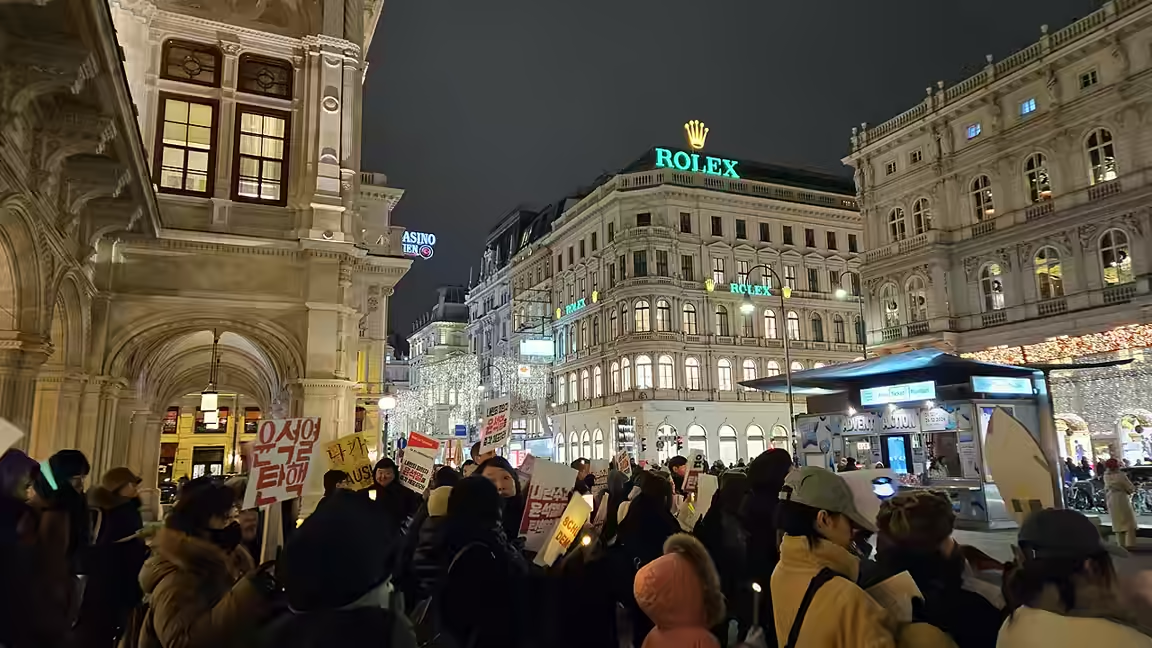
Protests continued after martial law was lifted. Thousands joined a candlelight march through central Seoul toward the presidential office, while another demonstration outside the National Assembly called for Yoon to step down. A woman filmed confronting a soldier inside parliament told the BBC that she acted because she believed the troops had to be stopped.
A lawmaker from Yoon’s People Power Party, Kim Gunn, called the declaration poorly coordinated and prepared and said the circumstances needed investigation. His comments showed that criticism was not confined to the opposition, although the supplied reporting did not establish the position of the governing party as a whole.
Institutions return to operation
By Wednesday, South Korea’s deputy prime minister sought to reassure foreign governments and financial institutions that martial law had ended and that the country’s political and economic systems were operating normally. The message was reportedly sent to major partners including the United States, Japan and China.
Markets nevertheless registered the shock. The won fell to a level not seen in nearly two years, while the Kospi share index was down 1.4 percent in the BBC’s December 4 coverage. Those moves occurred after the event date and are included as immediate consequences, not as conditions at the moment Yoon made his announcement.
The international response emphasized South Korea’s constitutional process. US Secretary of State Antony Blinken welcomed the withdrawal and said political disagreements should be settled peacefully. His remarks likewise came on December 4, after lawmakers had overturned the declaration.
The episode lasted only a few hours, but its political effects continued into the next day. Parliament had forced a reversal, protesters demanded Yoon’s resignation, members of his administration sought to leave their posts and an impeachment effort had begun. The evidence supplied for this report captures that immediate aftermath; it does not establish the later outcome of the impeachment process.


