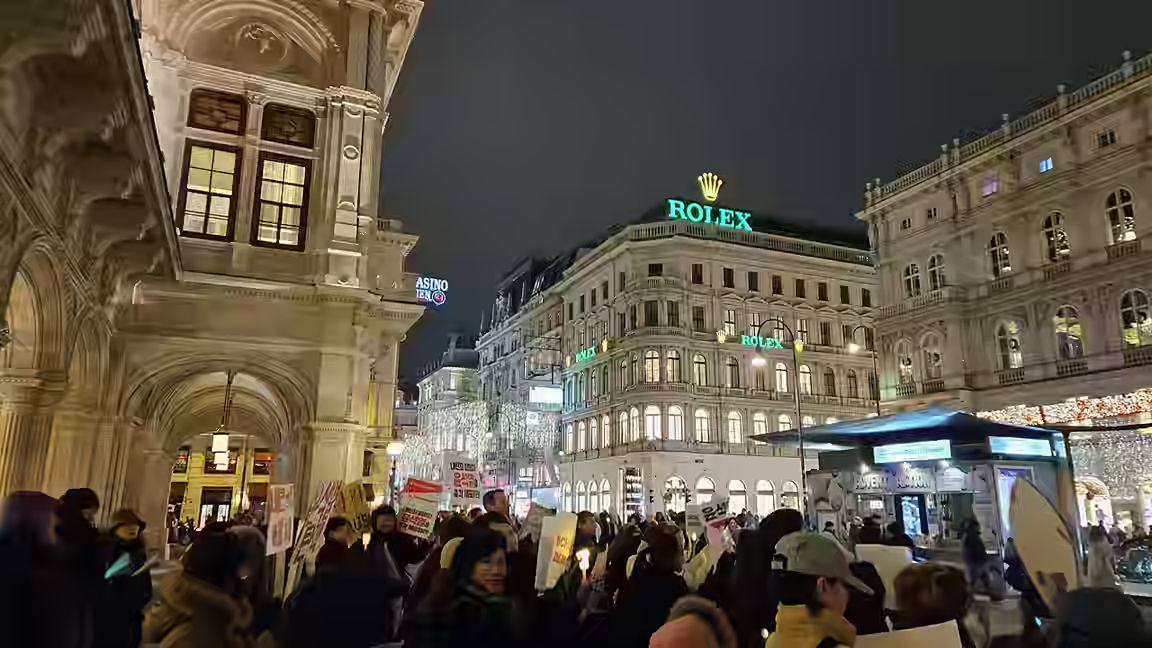
South Korean labor groups moved ahead with strike plans on 2024-12-04 after President Yoon Suk Yeol’s surprise declaration of emergency martial law, turning a political crisis into an immediate industrial confrontation. The clearest case in the evidence came from the Korean Confederation of Trade Unions transport union, which said it would strike on December 5 and 6 despite the declaration.
According to Maeil Business Newspaper, the union issued a statement saying it would continue to strike against what it called a regime that had declared martial law and that it would not submit to the measure. The report said the union planned an indefinite full-scale strike from December 5 if talks with management failed, and that unions at the Seoul Transportation Corporation were also preparing action for December 6. The National Education Public Officials Headquarters also announced a one-day strike for December 6.
The timing matters. Yoon’s declaration, made on December 4, immediately altered the political atmosphere in which unions were operating. The union response was not just a labor dispute over wages or workplace conditions. It became a direct protest against the use of martial law, with the transport union arguing that such a measure is reserved for extreme circumstances and that the president’s decision threatened constitutional values and democratic norms.
The newspaper excerpt also recorded that the martial law command decree included a ban on strikes, neglect and assembly that promote social chaos. That detail helps explain why labor groups treated the announcement as a direct challenge to their right to organize. Their response suggested that the declaration had the opposite effect from what government authorities may have intended: it hardened resistance and gave unions a common political target.
The evidence supplied for the story is narrow, so the verified facts should remain narrow too. What can be said with confidence is that the KCTU transport union publicly kept its strike dates, that Seoul Transportation Corporation unions and the National Education Public Officials Headquarters also announced action, and that those moves were explicitly tied to Yoon’s martial law declaration.
The broader picture is one of a country where a constitutional and political shock quickly spilled into the workplace. Transport and education unions were not waiting to see whether the announcement would be reversed or softened. They were preparing to act on the calendar already in place, presenting the strike as both a labor tactic and a political statement.
The result was a fast collision between state power and organized labor. The government’s emergency declaration was treated by the unions as a reason to escalate, not to stand down, and the public transport sector became one of the first arenas where that confrontation was set to play out.


