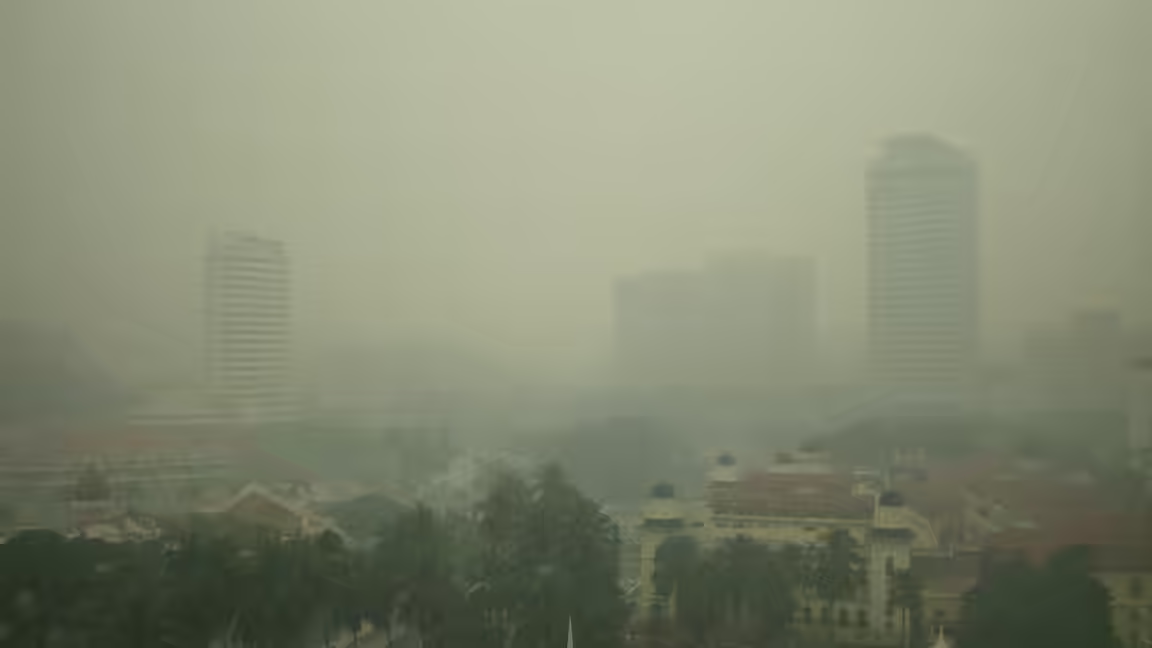
Iran ordered all governmental offices, universities and schools in Tehran province closed for two days because of poor air quality, according to the AP report. The move covered the country’s capital and its surrounding province, where visibility was low and health warnings were already being issued to children, older people and the sick.
The closure was broader than the one in place just days earlier. The report says elementary schools and kindergartens in Tehran had already been shut on the preceding Saturday and Sunday, but authorities extended the measures on Tuesday by closing all government offices, universities and schools for Wednesday and Thursday. Schooling was expected to continue online. That detail shows the government is trying to keep education going while reducing exposure outdoors.
The report also says banks, essential public services and health centers would remain open. That matters because it shows how the Iranian authorities are trying to isolate the disruption to nonessential parts of daily life. In a city of more than 10 million people, even a limited closure can ripple quickly through commuting, work and family routines, so keeping key services open is central to preventing the policy from becoming a larger shutdown.
Tehran is not new to pollution problems, but the piece makes clear that the current smog is being driven by a combination of heavy traffic, fuel-burning cars, motorbikes and factory emissions. Winter weather makes the situation worse because of weak wind and rain. The city’s geography adds another layer of difficulty: it sits in a valley surrounded by tall hills and mountains on three sides, which traps the pollution instead of letting it disperse.
That physical setting helps explain why officials keep returning to temporary closures when the air turns bad. The AP report says such measures are used from time to time, which suggests the government sees them as a recurring emergency tool rather than a one-time policy shift. The closures in neighboring Alborz province and in Isfahan show the problem is not confined to one city either.
The report also gives a sense of the region’s school calendar, noting that schools in Iran usually operate from Saturday to Wednesday. That makes the weekday closure especially disruptive, because it hits what would normally be the middle of the school week. The government is effectively asking families and institutions to absorb several days of friction in exchange for limiting health risks.
The article does not present the closures as a permanent fix, and that is part of the story. Tehran’s air quality is among the worst in the world, so the recurring emergency response underlines how persistent the pollution problem has become. Closing offices and schools may lower immediate exposure, but it also shows how difficult it remains to solve the underlying mix of traffic, emissions and trapped winter air.
The closures are therefore a stopgap, not a cure. They buy time for hospitals, schools and commuters, but the report makes clear that Tehran will keep living with the same winter conditions until traffic, emissions and urban planning change in ways that go far beyond a two-day shutdown.