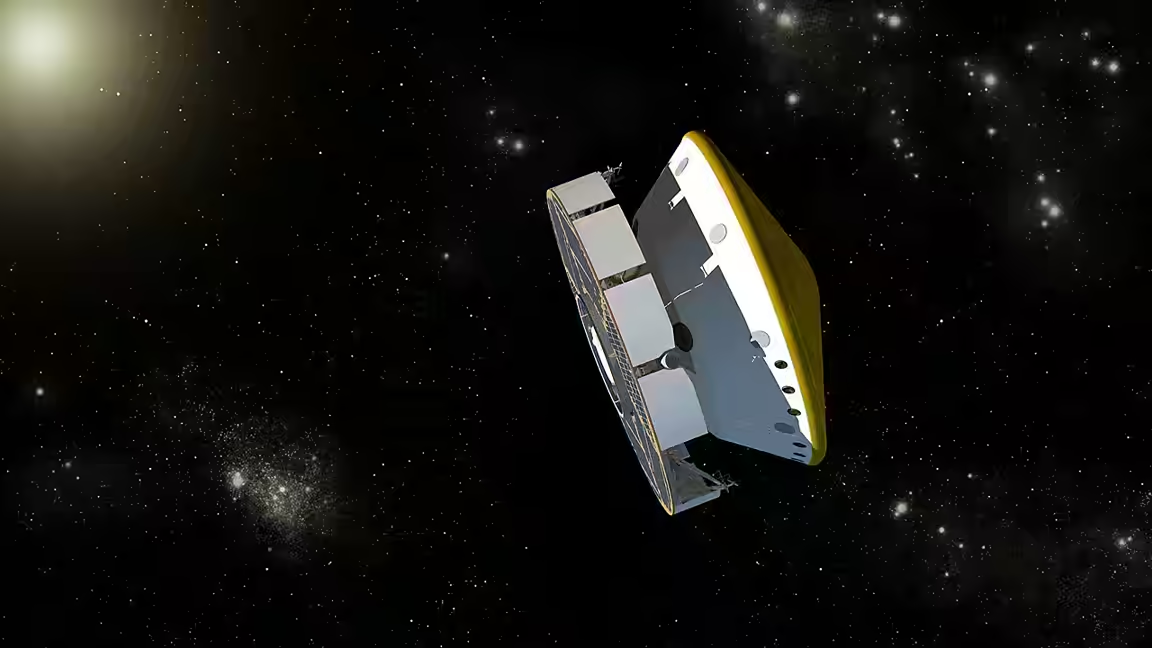
NASA’s Parker Solar Probe attempted its closest-ever pass by the Sun on December 24, 2024, flying through the star’s outer atmosphere while temporarily out of contact with Earth. Mission controllers expected a status signal on December 28 to confirm whether the spacecraft had survived the most demanding stage of its journey.
At closest approach, Parker was due to pass about 6.2 million kilometres from the solar surface. That is a small fraction of the approximately 150 million kilometres separating Earth and the Sun. The manoeuvre followed 21 previous solar passes since the probe’s 2018 launch, with each phase using the mission’s trajectory to move progressively nearer.
The spacecraft was expected to travel at roughly 430,000 miles per hour, faster than any other human-made object. Its speed came from the Sun’s gravity as it fell inward, allowing the probe to cross the harshest region quickly. A carbon-composite shield 11.5 centimetres thick protected its instruments and electronics from temperatures projected to reach about 1,400C and from intense radiation.
The mission’s purpose extends beyond setting distance and speed records. Parker collects observations inside the corona, the diffuse outer atmosphere visible during a total solar eclipse. Scientists want to understand why the corona reaches millions of degrees even though the Sun’s visible surface is around 6,000C. Direct measurements from within that environment offer information that remote observation alone cannot provide.
Researchers are also examining the solar wind, the stream of charged particles flowing outward from the corona. Interactions between those particles and Earth’s magnetic field can generate auroras, but stronger solar activity can also disrupt electrical grids, satellites, electronics and communication systems. Better knowledge of where the wind originates and how it accelerates may improve understanding of such space-weather events.
The communications blackout was planned, not evidence of a failure. The probe could not report during the fly-by, leaving the team to wait until it emerged from the encounter. NASA science chief Nicola Fox said the spacecraft had been engineered for the conditions but acknowledged the tension involved in awaiting its signal.
December 24 was the event date of the attempt, rather than a claim that results were already available. At that stage, the evidence established Parker’s planned path, operating conditions and scientific objectives; survival still depended on the later contact. If confirmed healthy, the probe was expected to continue orbiting the Sun and gathering data during further passes.

