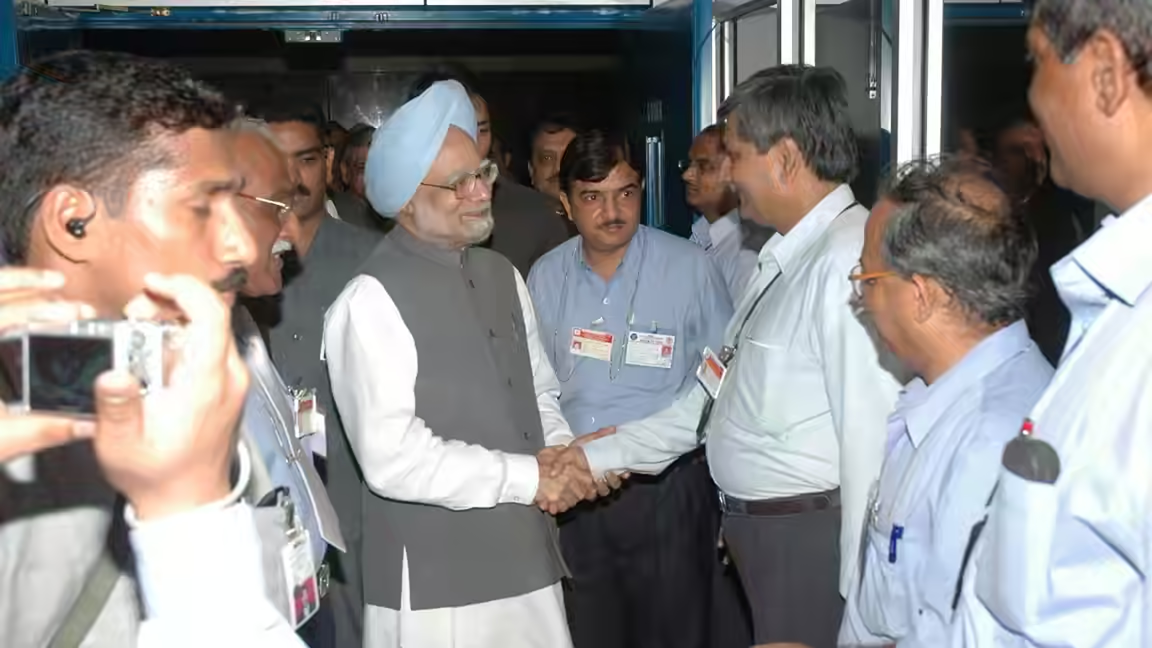
# Manmohan Singh, India’s former prime minister, dies at 92
*Event date: 2024-12-26*
Manmohan Singh, who served as India’s prime minister and became one of the most influential figures in the country’s economic and political life, has died in New Delhi at the age of 92.
The news marks the end of a long public career that stretched from economic policymaking to the highest elected office in the country. According to the supplied report, Singh died after being admitted to AIIMS hospital. The Times of India said he was remembered as a key architect of India’s reform era and as a veteran leader of the Congress party.
Singh’s death is significant not only because of his former office, but because of the role he played in the country’s modern political history. He was closely associated with India’s economic liberalisation and later became the face of the government that governed from 2004 to 2014. In public memory, he was often seen as a reserved and technocratic leader, but one whose policy influence reached far beyond his demeanour.
The immediate fact of his death places one of India’s best-known elder statesmen into the historical record. The report does not add detail about the cause of death, and no such claim is needed to understand the scale of the moment. At 92, Singh had already outlived many of his contemporaries from the era in which he helped shape policy and national debate.
His career carried weight across party lines and among observers of India’s post-reform economy. Singh’s name was tied to the broad opening of the economy and to later debates over how that growth was distributed. For supporters, he embodied competence and continuity. For critics, he represented the constraints of coalition politics and the difficulty of translating policy expertise into political force. Both readings point to the same fact: Singh mattered because he was central to the machinery of Indian governance.
The report from the Times of India is limited in detail, but the core news is clear. One of India’s most recognisable former leaders has died in the capital, and the country is losing a figure whose influence extended from the cabinet table to the design of its economic trajectory.
As public tributes and official statements follow, Singh’s legacy will likely be debated in two overlapping registers. One is political, about what his government achieved and where it fell short. The other is historical, about how a quiet economist became a prime minister at a pivotal time. Both conversations begin from the same point: the death of a man who helped define an era.


