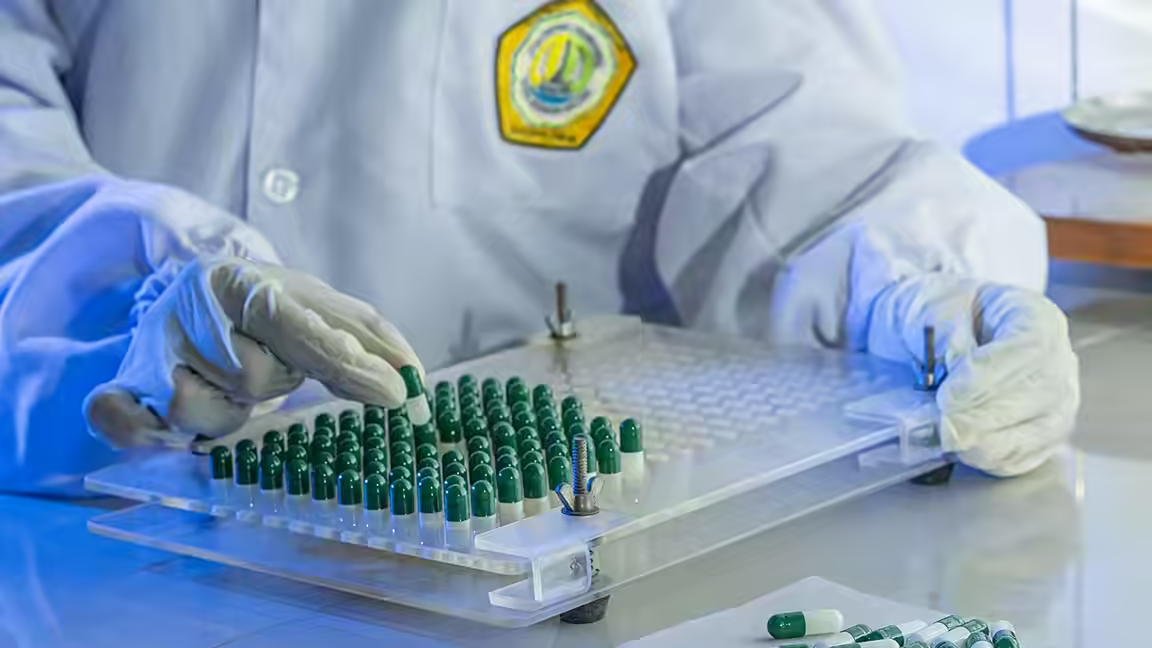
The U.S. Food and Drug Administration has moved to ban Red No. 3, the synthetic dye that gives many foods and drinks a bright cherry-red color and has been linked to cancer in laboratory animals. The agency said food manufacturers will have until January 15, 2027, to reformulate products, while companies making ingested drugs such as dietary supplements will get an extra year.
The ban ends a long and highly visible regulatory fight. According to the supplied NBC News report, Red No. 3 has been used in thousands of foods, including candy, cereals, fruit cocktails and strawberry-flavored milkshakes. The Center for Science in the Public Interest had petitioned the FDA in 2022 to revoke the additive's approval, arguing that the evidence of harm was sufficient to force action. The agency's move is therefore the result of a process that stretched back years, if not decades.
The FDA said evidence shows cancer in male rats exposed to high levels of the dye. That finding matters because the agency is invoking its authority under the Delaney Clause, which requires it to ban food additives found to cause or induce cancer in humans or animals. The same additive was already banned in cosmetics in 1990, so the new decision removes an odd regulatory split in which Red No. 3 was prohibited in lipstick but still legal in food.
The ruling does not extend to all synthetic dyes. NBC reported that the FDA is not prohibiting other artificial colors, including Red No. 40, which has also drawn criticism over possible behavioral effects in children. The agency has previously reviewed the possible link between artificial dyes and hyperactivity in children and said in 2011 that no causal relationship could be established. For now, the Red No. 3 action is a targeted ban rather than a broader rewrite of the food-coloring system.
The response from advocates was immediate. Dr. Peter Lurie of CSPI called the decision long overdue and said it removes an unnecessary hazard from the U.S. food supply. Melanie Benesh of the Environmental Working Group also praised the move and said she hoped regulators would look more closely at other artificial dyes. The Consumer Brands Association, by contrast, said food safety is the number one priority for companies and that the industry would comply with the ban. The trade group's reaction matters because the reformulation deadline will force manufacturers to change recipes, labels and supply chains across thousands of products.
The policy also has a state and international dimension. NBC said California and 10 other states had already moved to ban the dye, and that it is also banned or severely restricted in places such as Australia, Japan and the European Union. That context suggests the federal decision was not an isolated leap, but part of a widening global and domestic consensus that the dye no longer belongs in routine food production.
For consumers, the practical result is simple: Red No. 3 is on its way out of the food supply. For regulators, the decision shows the FDA is willing to act on evidence of animal carcinogenicity. For manufacturers, the deadline is now fixed. The long-running dispute over a bright red additive has finally reached a deadline with real commercial consequences.