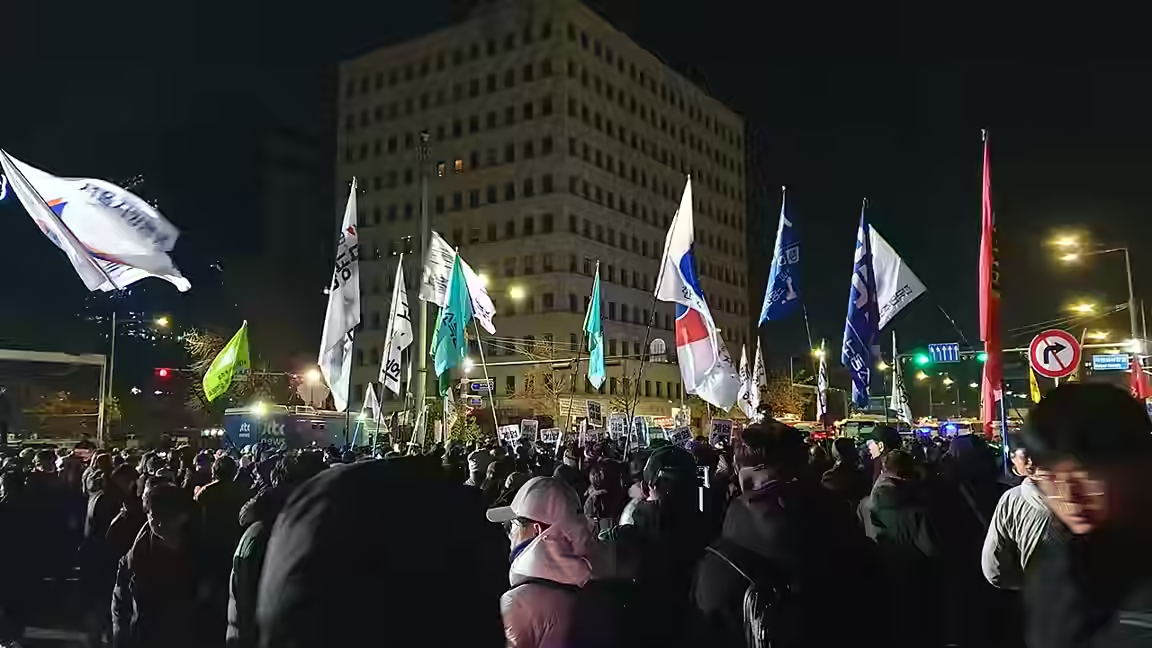
Yoon Suk Yeol became the first sitting president in South Korea's constitutional history to be formally arrested on January 19, 2025, after a court approved a warrant against him. The arrest added another dramatic turn to a political crisis that began after Yoon declared martial law in December and triggered an extraordinary confrontation between the presidency, investigators and the courts.
Yonhap reported that the warrant was granted on the 19th, making Yoon the first incumbent president ever to be detained in this way. That distinction is legally and politically significant in South Korea, where presidents have not been immune from scrutiny but the threshold for detaining a sitting head of state has never before been crossed. The arrest of an incumbent president places immediate pressure on the office itself, the ruling system around it and the broader question of executive accountability.
The report also placed Yoon's case in a longer historical frame. South Korea has seen former presidents investigated, indicted and imprisoned after leaving office, but the arrest of an incumbent is different. Yonhap noted that former president Roh Tae-woo had been the first former or sitting president ever to be jailed, followed later by Chun Doo-hwan, Park Geun-hye and Lee Myung-bak. In other words, the country has a long record of legal reckoning for top leaders, yet Yoon's case crossed a boundary that none of those earlier cases reached while the president was still in office.
That background helps explain why the arrest drew attention well beyond the courtroom. The legal move was not just about one politician's future. It became a test of whether South Korea's institutions can pursue criminal process against a sitting president while preserving a functioning state. The fact that the warrant was issued after Yoon's martial-law declaration in December only deepened the stakes, tying together constitutional emergency powers, political legitimacy and possible criminal exposure.
Yonhap's account emphasized the uniqueness of the moment by noting that Yoon was the first incumbent president to be arrested, even though former presidents had previously been jailed. That detail matters because it separates symbolic accountability from operational disruption. A former president can be processed as a private citizen. A sitting president brings the machinery of government into the center of the case, with all the practical and political consequences that follow.
The arrest also sharpened the public conversation about the balance between presidential power and constitutional restraint. A martial-law declaration is among the most severe powers available in a democratic system, and in Yoon's case it became the backdrop for a legal response that reached into the presidency itself. The sequence of events suggested that South Korea's institutions were prepared to act even when the subject was the head of state.
For South Korea, January 19 became a milestone not because the country had never seen presidential scandal before, but because it had. The difference was that this time the law caught up with a president still in office. Whatever happens next in Yoon's legal and political trajectory, the formal arrest already secured him a place in South Korea's constitutional record.


