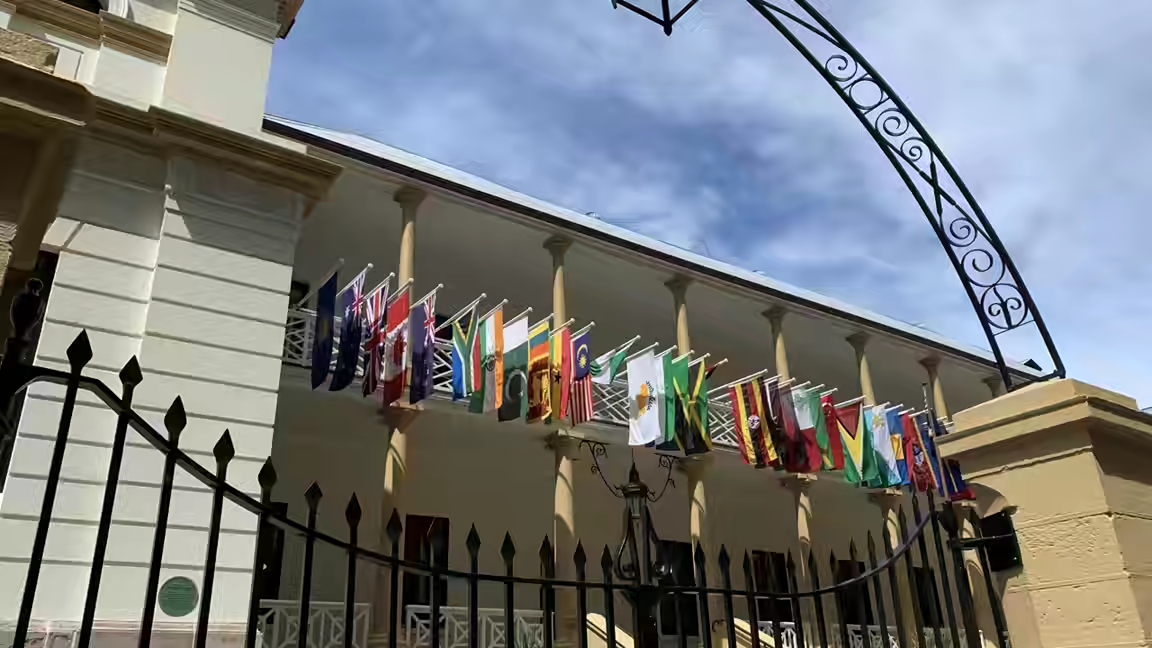
On Feb. 7, 2025, 79 countries issued a joint statement rejecting U.S. sanctions on officials at the International Criminal Court in The Hague. The signatories said the measures imposed by President Donald Trump could encourage impunity and damage the international legal order, and they warned that sanctions could seriously undermine the cases now before the court.
The statement was signed by a broad cross-section of countries, including the United Kingdom, Germany, France, the Netherlands and states such as Afghanistan, Bangladesh, Congo and Sierra Leone. Dutch Prime Minister Dick Schoof called the sanctions a worrying signal and said the ICC plays a crucial role in combating international crimes. German Chancellor Olaf Scholz also criticized the move, arguing that the United States was putting at risk an institution meant to ensure that dictators and war makers are not beyond reach.
The ICC itself denounced the sanctions as an attempt to damage its independent and impartial work. One practical concern is financial: banks may decide to suspend services to avoid being caught in the sanctions regime, which could interrupt the court’s daily operations and complicate basic transactions. That possibility gave the measure immediate consequences well beyond diplomacy. It also raised questions about whether the court could continue to function normally if banks interpret the U.S. restrictions in the most cautious way.
Trump imposed the sanctions in response to ICC arrest warrants for Israeli Prime Minister Benjamin Netanyahu and former defense minister Yoav Gallant over actions in the Gaza war. The warrants, issued in November, angered both the Israeli government and Washington. The controversy exposed a familiar divide around the court: 125 countries are members, but the United States, China, Russia and Israel are not. That means the ICC depends heavily on the political support and practical cooperation of states that are not themselves subject to the same institutional obligations.
Dutch authorities are now looking for ways to keep the court operating without interruption, including discussions with banks about the sanctions’ reach. That behind-the-scenes scramble underlines how quickly a diplomatic dispute can become an operational problem for an international institution. The statement by 79 countries was not only an act of solidarity with the court; it was also a warning that sanctions aimed at individual officials could end up constraining the institution’s ability to carry out its work at all.
The banking question may prove as important as the politics. If major financial institutions decide that dealing with the court is too risky, the ICC could be cut off from ordinary transactions even without a formal legal shutdown. That is why the Netherlands and other member states are looking for a practical fix while also defending the court in principle. The statement from 79 countries was therefore both a diplomatic rebuke and a warning that the sanctions could have immediate operational effects.
That operational pressure is why the dispute is so sensitive in The Hague and in capitals across Europe. The ICC can survive criticism, but it is much harder for it to function if ordinary payments, payroll and vendor relationships are threatened by sanctions spillover. For the court’s supporters, the joint statement was a way to say that legal independence should not be turned into a bargaining chip in a Gaza-related political fight.


