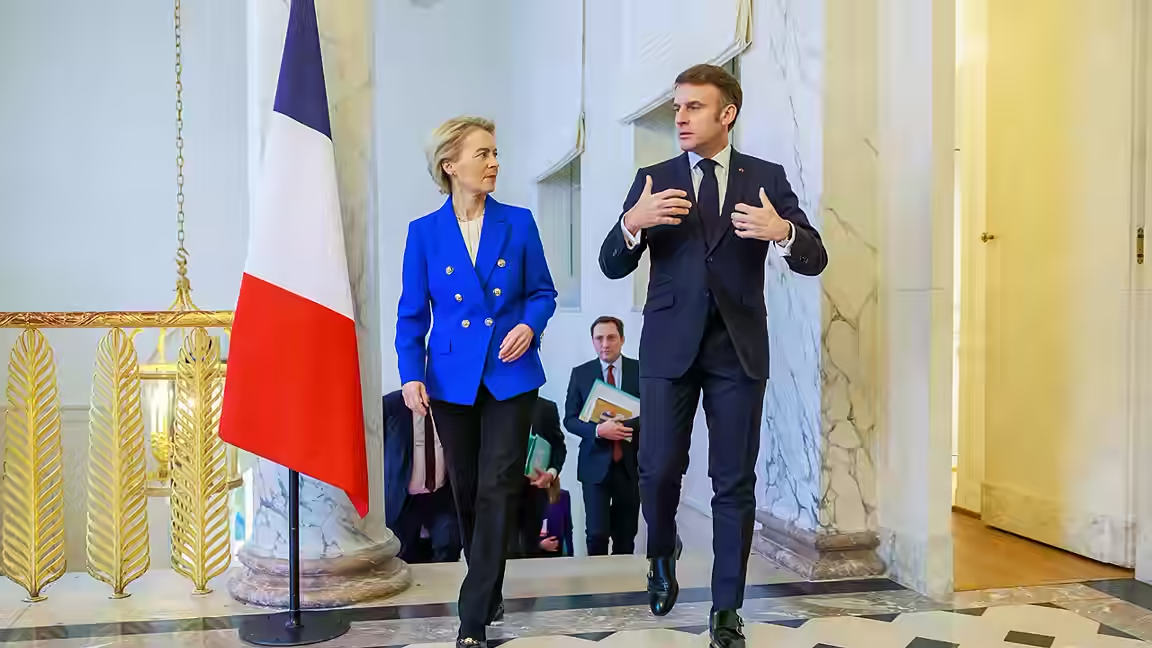
French President Emmanuel Macron told political leaders and technology executives in Paris that 109 billion euros in planned private artificial-intelligence investment had returned France to the global AI race.
Macron delivered the message at the Grand Palais during the opening day of the two-day AI Action Summit. France 24 reported that the investment was expected to arrive over the coming years. The announcement formed part of a broader effort to present France and Europe as credible competitors in an industry increasingly shaped by the United States and China.
The French president urged companies to choose Europe and highlighted France’s clean electricity supply as an advantage for power-hungry computing infrastructure. Contrasting his approach with US President Donald Trump’s energy slogan, Macron argued that France could connect new facilities to electricity without expanding drilling.
Macron co-hosted the gathering with Indian Prime Minister Narendra Modi. Heads of state, officials, executives and researchers from about 100 countries attended. Participants included US Vice President JD Vance, on his first foreign trip after taking office, and Chinese Vice Premier Zhang Guoqing. Senior figures from Google, Microsoft and OpenAI were also among those taking part.
Investment and public-interest AI
Organizers planned to launch a public-private partnership called Current AI. The Associated Press reported that it would begin with $400 million and seek to raise $2.5 billion over five years. The initiative was designed to give trusted AI developers open-source access to datasets, software and other tools for work intended to serve the public interest.
Macron’s team wanted to direct more attention toward data and systems that could help address problems such as cancer and long Covid, rather than focusing only on a race to build systems exceeding human abilities through greater computing power. Summit envoy Martin Tisné described the moment as an opportunity both to reduce AI harms and to improve people’s lives.
France 24 said the summit would examine uses of AI in health, education, the environment and culture. Mozilla public-policy executive Linda Griffin called the breadth of participation a chance to shape norms, while Eurasia Group analyst Nick Reiners said public-interest development could offer an alternative to control by a small number of private companies.
The meeting also served as a platform for investment announcements intended to strengthen Europe’s position. Macron’s €109 billion figure represented promised private investment, not public expenditure already completed or money confirmed as spent on the event date.
Governance amid US-China competition
The Paris gathering followed international meetings at Bletchley Park in Britain in 2023 and in South Korea in 2024. The first produced a nonbinding commitment from 28 countries to address AI risks. The second secured a pledge to form a network of public AI-safety institutes for research and testing.
Safety remained on the Paris agenda, including a report from experts on possible extreme risks from general-purpose AI. Organizers also broadened the discussion to include access, economic opportunity and public benefit. Like the previous summits, the Paris event was not expected to create binding regulations.
French organizers sought support for a political declaration promoting ethical, democratic and environmentally sustainable AI. The Associated Press reported uncertainty over whether the United States would sign. Trump had revoked his predecessor’s executive order on AI safeguards and was pursuing a policy intended to reduce regulatory barriers and maintain US leadership.
China’s emergence as a central competitor added urgency. The summit took place as DeepSeek’s lower-cost chatbot drew attention across the technology industry, placing questions of efficiency and access alongside the established debate over advanced systems and their risks.
Macron said the meeting was about setting rules rather than allowing AI development to become an uncontrolled contest. His declaration that France was back in the race combined two ambitions: attracting the capital and energy-intensive infrastructure needed to build AI, and giving Europe a larger role in deciding how the technology should be governed and used.


