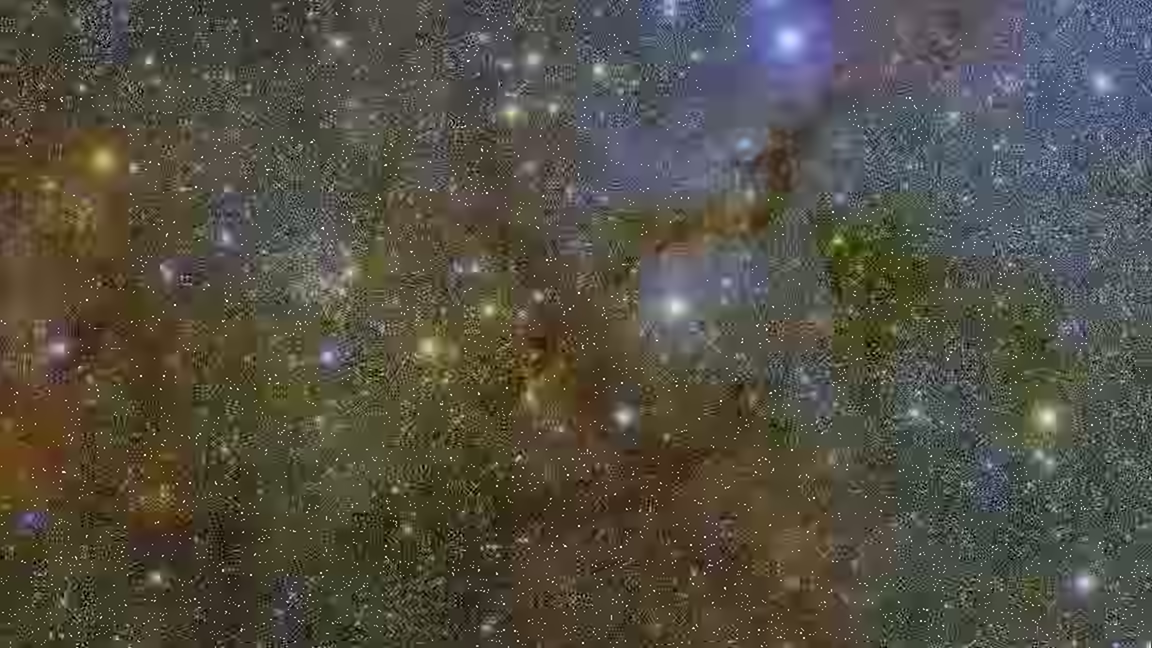
NASA's SPHEREx observatory launched from Vandenberg Space Force Base in California on March 11, 2025, beginning a mission to map the whole sky in infrared light. The spacecraft lifted off at about 8:10 p.m. Pacific time aboard a SpaceX Falcon 9 rocket after several delays caused by technical checks and weather.
SPHEREx stands for Spectro-Photometer for the History of the Universe, Epoch of Reionization and Ices Explorer. The $488 million mission is planned to operate for two years, completing four all-sky surveys during that period. Each survey will take about six months.
The observatory will examine the cosmos in 102 infrared wavelengths, more colors than any previous whole-sky mission, according to NASA. Infrared light is invisible to human eyes, but it carries information about the composition, temperature, density and distance of stars, galaxies and other objects. SPHEREx will use spectroscopy to split that light into its component wavelengths, producing a large data set for astronomers.
Scientists expect the mission to collect information on more than 450 million galaxies and build a three-dimensional map of the universe. One of its central goals is to investigate the first moments after the Big Bang, when the universe expanded rapidly. By measuring the distribution of galaxies across the sky, researchers hope to test ideas about how that early expansion shaped the structure visible today.
SPHEREx will also study how galaxies formed and changed over billions of years. Within the Milky Way, it will search clouds of gas and dust for water ice and other molecules associated with the ingredients of life. Those regions are where new stars and planetary systems emerge, allowing the telescope to connect large-scale cosmology with the chemistry of nearby stellar nurseries.
Four small satellites for NASA's PUNCH mission shared the launch. PUNCH will observe the Sun's outer atmosphere and follow how material from the corona becomes the solar wind flowing through the Solar System. Operating the missions together allowed NASA to place two separate science programs into orbit on one Falcon 9 flight.
SPHEREx does not focus narrowly on individual objects in the way some larger telescopes do. Its strength is uniform coverage: repeated observations of the entire sky in the same set of wavelengths. That broad catalog can identify targets and patterns for detailed follow-up by other observatories.
With the spacecraft in orbit, mission teams will commission its systems and begin the first survey. The resulting archive is intended to give astronomers a new reference map for studying cosmic history, galaxy evolution and the distribution of water-bearing material close to home.