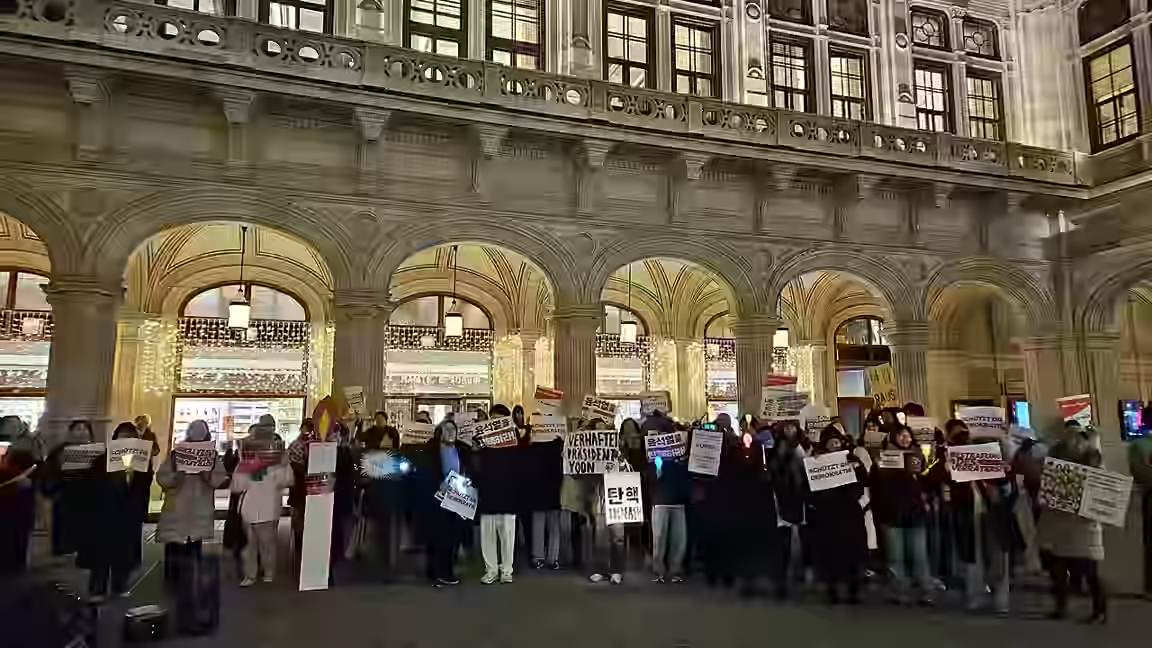
# South Korea court removes Yoon Suk Yeol in unanimous impeachment ruling
Event date: 2025-04-04
South Korea’s Constitutional Court has removed former President Yoon Suk Yeol from office in a unanimous 8-0 decision, ending weeks of anticipation after his impeachment over the martial law crisis.
The ruling, reported by The Korea Times, confirms that all eight justices voted to uphold the impeachment motion passed by the National Assembly. Acting Chief Justice Moon Hyung-bae said Yoon had deployed military and police forces to obstruct parliament’s constitutional authority and had betrayed the public trust placed in the presidency.
The decision takes effect immediately. It also sets in motion the constitutional requirement for a new presidential election within 60 days. The ruling came 111 days after lawmakers approved the impeachment motion, making the case one of the most consequential constitutional confrontations in South Korea in years.
The court’s conclusion turns on Yoon’s declaration of martial law on Dec. 3, which the justices found incompatible with democratic norms and the constitutional order. Moon’s reasoning, as quoted by The Korea Times, framed the president’s actions as a direct challenge to popular sovereignty and parliamentary authority. The court found no dissenting votes, with only a few separate opinions on specific issues.
Yoon’s removal also forces immediate practical changes at the presidential residence in Seoul. He and first lady Kim Keon Hee must leave the official compound in Hannam-dong. Under current law, a former president who does not finish a term can still receive security protection for up to 10 years, and any transition back to a private residence must be arranged with those protections in place.
Acting President Han Duck-soo said in a national address that he would prioritize security, foreign affairs, the economy and public order while the country moves toward a new election. Senior staff at the presidential office resigned later in the day, although Han rejected those resignations to avoid a vacuum in state affairs.
The political response was immediate. The ruling People Power Party apologized to the public and said it accepted the court’s decision. The main opposition also moved quickly to frame the ruling as a warning against future constitutional disruption.
The judgment is South Korea’s second presidential removal by constitutional impeachment, after Park Geun-hye’s ouster in 2017. That precedent makes the next 60 days especially important: the country must organize a vote while managing a sudden leadership reset and an already polarized political environment.
For now, the court’s decision closes the legal chapter on Yoon’s presidency. What remains is a rapid transition to a new election, with the ruling also likely to reshape the balance inside both major parties and reframe the debate over civil-military authority in South Korea.


