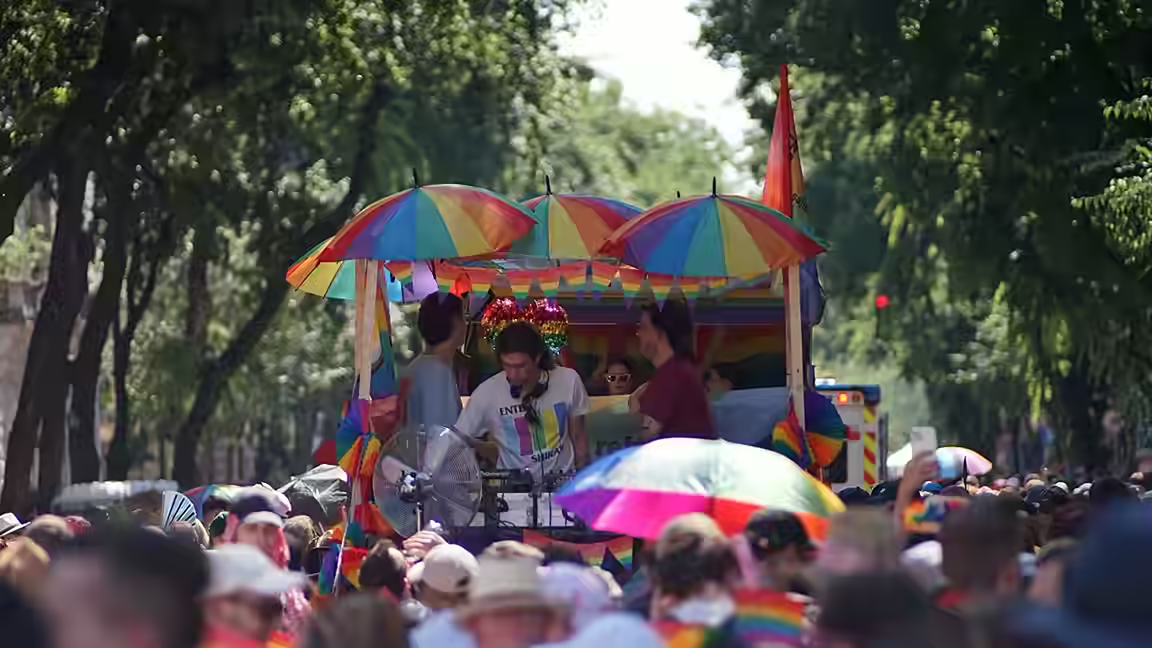
Tens of thousands of people have gathered in Budapest for Pride despite a police ban and repeated warnings from Prime Minister Viktor Orban’s government. Organizers estimated that as many as 200,000 people could have taken part, making the march one of the largest public displays of LGBTQ solidarity in Hungary in years and a direct challenge to the government’s effort to suppress it.
The ban rests on a new child-protection law that officials say allows them to stop gatherings deemed to promote homosexuality. Police warned that attendees could face fines and that organizers could face prison sentences. Orban tried to lower the temperature before the event, saying police could break up such gatherings but would not use physical force. He also made clear that legal consequences could follow. The combination of threat and restraint was part of the government’s message: the march should not be taken as evidence that the rules no longer apply.
The crowd’s response showed the opposite. Participants told the BBC they were attending to defend diversity, equality and the right to love who they choose. One attendee said the law was hurting people’s rights and that she feared for her young daughter’s future in a country where people cannot love freely. Another marcher said he was there in solidarity because he knew what it felt like to be treated as an outcast. Those reactions show that Pride in Budapest has become more than a festival; it is now a test of how much room remains for dissent and minority rights in Hungary.
The event has also become a European political issue. EU equalities commissioner Hadja Lahbib was in Budapest and expected to join the march, and several members of the European Parliament were also planning to attend. European Commission president Ursula von der Leyen had asked Orban not to block the event, while Budapest mayor Gergely Karacsony insisted that no one attending could face reprisals because the march was co-organized by city hall and therefore did not need police approval. Orban rejected that framing and told von der Leyen to stay out of domestic law-enforcement affairs.
That clash matters because it places Budapest Pride at the intersection of local protest and wider democratic anxiety. The march is about LGBTQ rights, but it is also about the legitimacy of public assembly, the use of facial recognition technology, the threat of fines and the willingness of a government to police the boundary between civic life and political conformity. The evidence in the packet suggests that the crowd turned out anyway, in numbers large enough to challenge the ban in practice even if the legal fight is far from over.
The march’s size matters because it makes the ban harder to enforce politically even if it remains on paper. A crowd this large, attended by European officials and defended by city hall, turns a domestic dispute into a broader test of Hungary’s democratic norms. Orban may still have the legal tools to punish attendees, but the evidence shows that many participants were willing to take that risk to assert that public space belongs to them as well.


