Hundreds of thousands of people gathered in Budapest on Thursday, October 23, 2025, for rival rallies that highlighted the intensity of Hungary's political fight ahead of next spring's parliamentary election.
One march backed Prime Minister Viktor Orbán and his government. The other supported Péter Magyar, the opposition leader who has emerged as Orbán's strongest challenger and may give the long-serving prime minister his most competitive election since he returned to office. The vote is due in April, although the exact date has not yet been set.
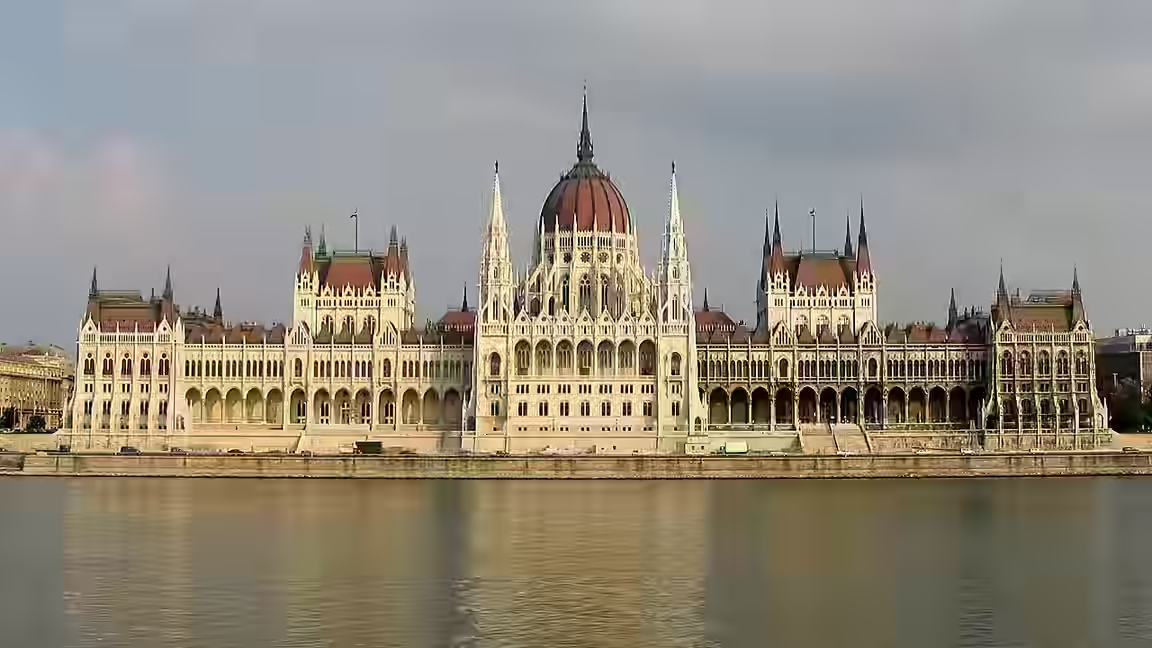
Orbán's supporters assembled on a bridge over the Danube and moved toward the neo-Gothic parliament. Their event was billed as a peace march and was held on Hungary's Oct. 23 national holiday, which marks the anniversary of the 1956 uprising against Soviet rule. Many participants linked their message to Orbán's warnings that foreign powers are trying to drag Hungary into Russia's war in Ukraine. A banner at the front of the march read: 'We don't want to die for Ukraine.'
In his speech, Orbán attacked Ukraine and the European Union, saying Kyiv had long ceased to be sovereign and warning that Ukraine could not join either the EU or NATO-like military structures without bringing war and economic damage. The AP described Orbán as Russian President Vladimir Putin's closest partner in the EU and said he has kept warm ties with Moscow while opposing Western support for Ukraine since Russia's full-scale invasion in February 2022.
Later in the day, Magyar drew large crowds to a separate rally in a central square and nearby avenues. Supporters of his Tisza party used the event to voice frustration over inflation, health care, corruption allegations and the concentration of power under Orbán's rule. Some marched with the old anti-Soviet slogan 'Russians go home!', reflecting anger over what they see as Hungary's drift toward Moscow.
Magyar, a 44-year-old lawyer and former Fidesz insider, has built momentum by focusing on everyday economic concerns rather than abstract ideological themes. He recently finished an 80-day tour of the country, holding town-hall style events across rural areas that have traditionally been reliable for Orbán's party. At the Budapest rally he accused Orbán of impoverishing the country and dividing Hungarians, but also urged supporters to remain calm and treat opponents with respect after the election.
The dueling demonstrations matter because they offered a public test of enthusiasm. Orbán has been slipping in the polls behind Magyar's Tisza, and his camp has struggled to energize voters. Even so, the AP said the prime minister remains popular with a substantial share of the electorate and was able to mobilize large numbers on Thursday.
The day also carried historical weight. Hungary's Oct. 23 holiday commemorates the uprising crushed by Soviet forces in 1956, and both camps drew on that symbolism to frame their present-day fight over sovereignty, identity and the country's place in Europe. For Orbán, the rally was a show of strength and a warning against war. For Magyar, it was a chance to show that the opposition could mobilize at scale and turn discontent into an electoral challenge.
With the campaign season entering its final stretch, the rallies suggested that Hungary's next election will be fought not only over policy, but over competing ideas of national direction: a government arguing for resistance to outside pressure, and an opposition promising change after 15 years of Orbán's rule.


