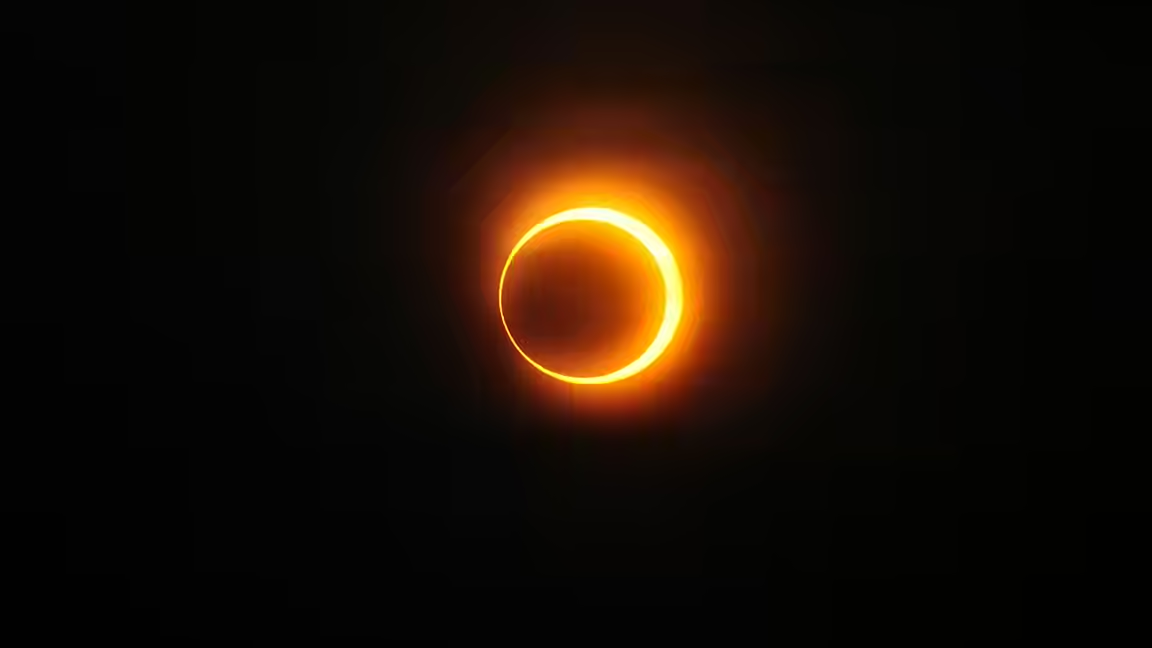
The year's first solar eclipse brought an annular, or “ring of fire,” phase to a narrow path across Antarctica. Very few people were positioned to see the ring directly, while a much wider region had the chance to observe a partial eclipse if weather conditions allowed.
An annular eclipse occurs when the sun, moon and Earth align but the moon is farther from Earth in its orbit and appears slightly too small to cover the entire solar disc. The moon blocks the centre while a narrow bright edge remains visible around it. Unlike a total eclipse, daylight dims without the sun disappearing completely.
The Associated Press described Antarctica as the only continent within the ring-shaped phase. Partial views were possible from the southern ends of Chile and Argentina and from parts of southeastern Africa, including Madagascar, Lesotho and South Africa. The supplied reports did not confirm cloud conditions or how many people actually observed the event at any location.
A Polish science report said the annular phase began over Antarctica at 11:43 and reached its maximum at 12:11, without specifying the time standard in the supplied extract. It said the most complete ring lasted a little more than two minutes. That evidence supports a duration exceeding two minutes, but not the discovery note's more exact claim of two minutes and 20 seconds.
The eclipse was difficult to reach because its central path crossed remote southern territory. Research-station staff and wildlife in Antarctica were among the few directly beneath it. Elsewhere, observers saw only part of the sun covered, with the amount varying by location.
Eye protection remained essential throughout the event. Looking directly at the sun can injure vision even when most of it is hidden. AP advised using eclipse glasses marked for the ISO 12312-2 standard and warned that sunglasses and binoculars were not adequate protection. The Polish report likewise recommended purpose-built filtered glasses or indirect projection.
A pinhole projector offered a way to follow the eclipse without looking toward the sun. Household objects with small openings, such as a colander, could also cast multiple images of the crescent-shaped sun onto the ground.
The February event preceded a total solar eclipse expected in August over parts of Greenland, Iceland, Spain, Russia and Portugal, with a partial phase across wider sections of Europe, Africa and North America. That later event was forecast to be much more accessible to travellers than the Antarctic annular path.

