# Boat carrying Afghan migrants capsizes off Bodrum, killing at least 19
A migrant boat carrying Afghan nationals capsized in the Aegean Sea off the Turkish resort city of Bodrum on Wednesday, leaving at least 19 people dead in one of the latest deadly crossings along the route between Turkey and nearby Greek islands.
Turkish authorities said the boat was trying to evade the coast guard in rough waters when it began taking on water and eventually overturned. The Turkish Coast Guard Command said the vessel had ignored repeated warnings to stop and instead attempted to flee at high speed. At least 20 other migrants were rescued.
The search effort continued after the initial rescue operation. According to the AP report, crews first pulled 21 survivors from the water and recovered 18 bodies. One of the migrants later died in hospital, bringing the death toll to 19. The coast guard also said at least one other person remained unaccounted for.
The victims were all from Afghanistan, and officials said the dead included a baby. That detail underscores the human cost of a route that is often described in bureaucratic terms but is in practice a dangerous crossing taken by people fleeing conflict and poverty. The area off Bodrum is close to the Greek island of Kos, one of several islands that sit only a short distance from the Turkish coast but remain separated by waters that can become lethal in bad weather or during fast-moving attempts to avoid interception.
Bodrum itself is better known as a vacation destination than a migration flashpoint, which is one reason accidents there draw attention quickly. But the wider Aegean corridor has long been a route for small boats trying to reach European territory. The AP report notes that Greece is one of the main entry points into the European Union for people fleeing hardship in the Middle East, Africa and Asia, and that many of the boats used are unseaworthy or set off in poor conditions.
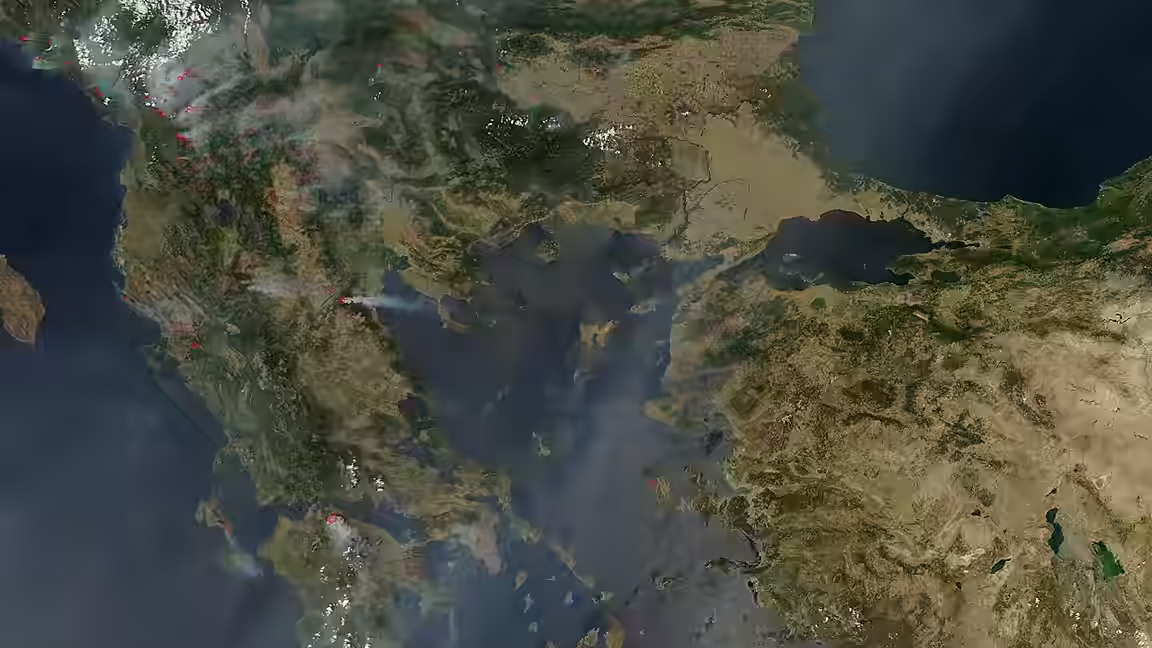
The geography helps explain the risk. Turkey’s western coast lies close to a string of Greek islands, including Kos, Kalymnos, Leros and Symi, making the voyage short in distance but dangerous in execution. Even a relatively brief crossing can become fatal when boats are overcrowded, weather turns rough or crews try to outrun the coast guard.
The latest incident also highlights the practical challenges facing rescue teams. The coast guard had to respond in rough water and deploy air support from nearby Izmir. The combination of bad sea conditions and the speed of the boat’s attempted escape likely made the rescue more difficult, though the AP report does not speculate beyond the official description.
For the surviving passengers, the immediate story is one of rescue and uncertainty. For the families of those who died, it is a reminder that the Aegean route can turn deadly in minutes. And for regional authorities, it is another case that points to the same underlying problem: migrants taking desperate risks on a sea crossing that remains short on the map but unforgiving in reality.