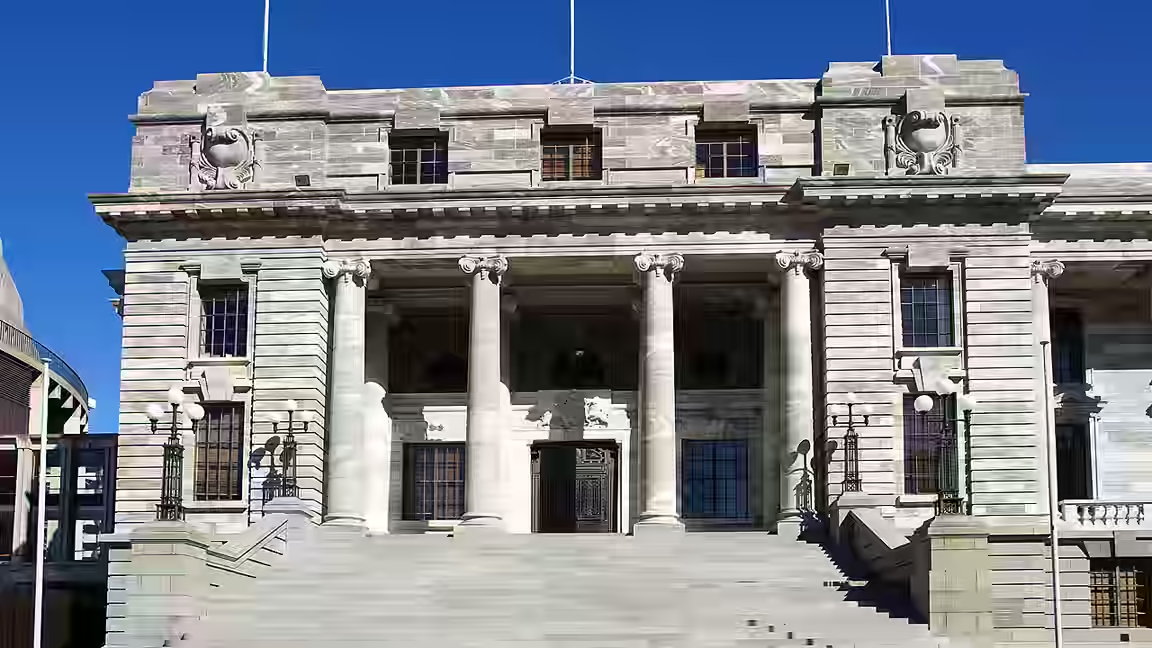
Myanmar’s parliament elected Senior General Min Aung Hlaing as president on April 3, 2026, formalising a political transition that left the military’s leader at the head of state. He received 429 of 584 votes in the combined upper and lower houses.
Min Aung Hlaing was one of three nominees, but parties backed by the military and members appointed by the armed forces held a commanding parliamentary majority. Former general Nyo Saw received 126 votes, while Karen politician Nan Ni Ni Aye received 29. Under the system, both runners-up became vice presidents, with Nan Ni Ni Aye set to be the first woman to hold that office. The three were expected to be inaugurated the following week.
The 69-year-old general relinquished his position as commander-in-chief before the vote because Myanmar’s constitution prohibits the president from simultaneously holding the military’s top command. Gen. Ye Win Oo, a close aide, took over that role.
The election gave Myanmar a nominally elected government five years after Min Aung Hlaing overthrew Aung San Suu Kyi’s civilian administration in 2021. Opponents and independent observers said the polls organised by the military were neither free nor fair. Major opposition parties were excluded or refused to participate, including Suu Kyi’s National League for Democracy.
Parliamentary elections were conducted in three phases in December and January but could take place in only 263 of Myanmar’s 330 townships because of security conditions. Suu Kyi, 80, was serving a 27-year prison sentence on charges widely viewed as politically motivated.
The country remained embroiled in civil war. After security forces used deadly force against peaceful demonstrations following the coup, pro-democracy activists formed armed resistance groups and allied with ethnic organisations that had long fought for autonomy. The National Unity Government, Myanmar’s principal opposition body, rejected the presidency and said resistance would continue.
Nearly 8,000 activists and civilians had been killed since the takeover, while 22,872 political detainees remained imprisoned, according to the Assistance Association for Political Prisoners. The Armed Conflict Location & Event Data Project recorded 1,140 military airstrikes in 2025, which accounted for hundreds of civilian casualties.
Min Aung Hlaing also faced international allegations. The International Criminal Court began examining alleged crimes against humanity related to the military’s persecution of the Rohingya after its prosecutor sought an arrest warrant in 2024. Myanmar separately defended itself at the International Court of Justice against genocide accusations brought by Gambia. Those proceedings had not produced a finding against him in the reporting.
China and Russia supported the military administration, while Western countries imposed sanctions. The new civilian title was seen partly as an attempt to improve relations with Southeast Asian neighbours, but the structure of parliament, the exclusion of opposition forces and continued war meant the army retained decisive power.


