A bridge collapse in Jammu’s Bantalab area on event date 2026-05-01 left three people dead and two others injured, according to officials quoted after a 12-hour rescue operation.
The collapse happened while labourers were carrying out retaining wall and foundation work on an old bridge that had already been damaged in flash floods last year. The section gave way in the Thuther area of Bantalab and trapped four people beneath debris, prompting a large emergency response through the night.
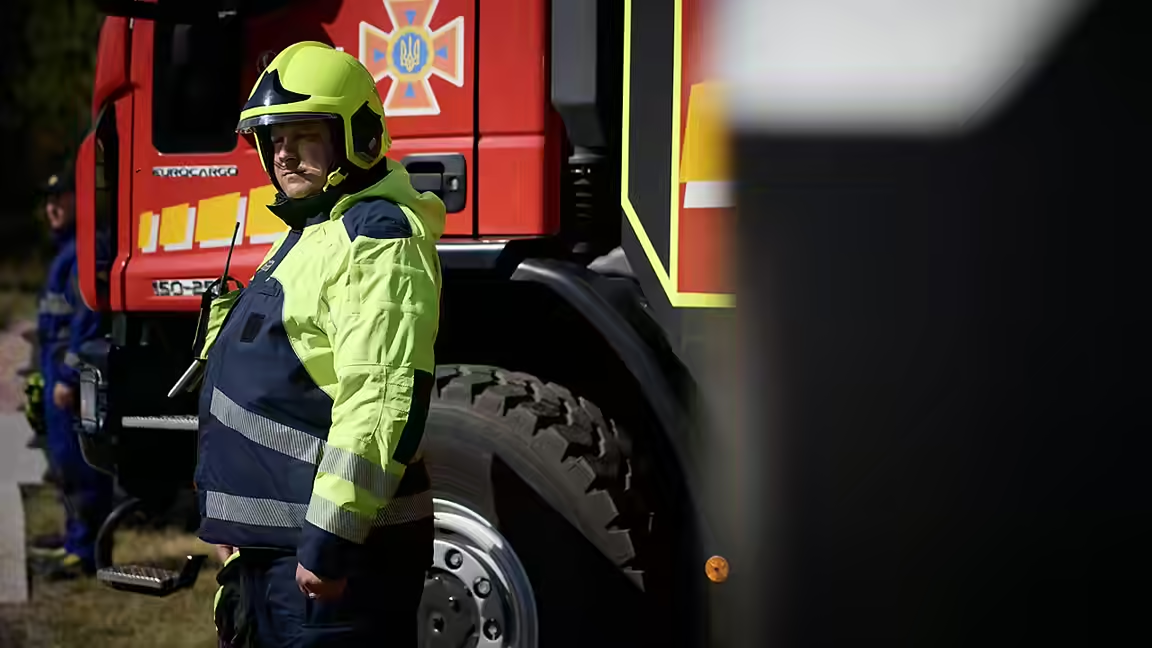
Police, the Army, the National Disaster Response Force, the State Disaster Response Force and the fire and emergency department all joined the search. One injured worker was rescued soon after the collapse, and the remaining victims were recovered during the overnight operation under floodlights. A senior officer said three bodies had been found and two people had been rescued alive but injured.
Among the injured was Divisional Fire Officer Mohammad Jaffar, who was struck by a boulder during the response. The injured were taken to hospital. Officials said the rescue itself was still under way as the scene was secured and teams worked through unstable debris.
Deputy Chief Minister Surinder Kumar Choudhary reached the site after midnight and ordered immediate administrative action. Assistant Executive Engineer Sahil Verma and Junior Engineer Sajad Mir were suspended pending inquiry, and the engineer-in-chief was told to attach the executive engineer. Authorities also formed a three-member committee to examine what went wrong and were told to complete the probe within five days.
The collapse adds to wider scrutiny over damaged infrastructure in the region after severe weather. In this case, the bridge had already been weakened by earlier floods, and the incident occurred while repair work was being carried out. Officials have not publicly set out a full technical explanation, but the combination of a fragile structure, active construction and a fatal collapse is likely to intensify questions over supervision and site safety.
For local residents and the workers involved, the immediate focus has shifted from repair to recovery and accountability. The government’s inquiry will now have to determine whether the collapse was caused by structural weakness, workmanship, oversight failures or a mix of those factors.
The government’s five-day deadline suggests officials want the inquiry to move quickly, likely because the collapse touches both public safety and public trust. In a case like this, the questions extend beyond who was on the bridge at the time. Investigators will need to map whether the structure had been properly closed, whether the work was being supervised and whether the repair plan matched the bridge’s weakened condition after the floods.
For the community, the immediate meaning of the collapse is not only the loss of life but also the possibility that a damaged route could remain unusable until the inquiry is complete. That would affect movement, construction work and access in the area. The source does not say how long the bridge had been under repair, but it is clear that a structure already weakened by weather failed while work was underway.