British Army medics have parachuted onto Tristan da Cunha, the remote British overseas territory in the South Atlantic, to help treat a British national with suspected hantavirus after a cruise ship outbreak left local supplies at a critical level.
The Ministry of Defence said the operation involved six paratroopers and two medical clinicians from 16 Air Assault Brigade, who jumped from an RAF A400M transport aircraft supported by an RAF Voyager. The aircraft flew from RAF Brize Norton to Ascension Island and then on to Tristan da Cunha. In a first for the UK military, the operation also included the delivery of oxygen and 3.3 tonnes of medical supplies to the island, which has no airstrip and a population of 221.
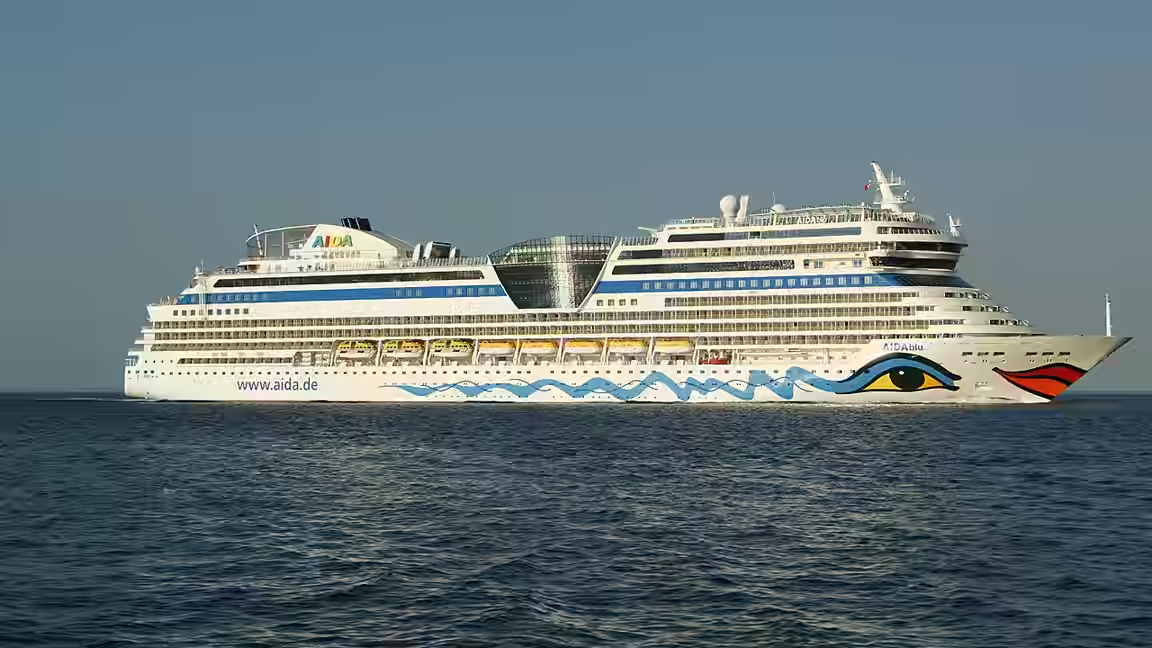
According to the BBC’s reporting, the British national on Tristan da Cunha had previously disembarked from the MV Hondius cruise ship in mid-April, later developed symptoms and is now said to be in a stable condition while isolating. The report says he first reported diarrhea on April 28 and a fever two days later. The man had been on the ship when the outbreak emerged, and the island’s isolation made road or air evacuation impossible. The lack of an airstrip meant the only practical route for urgent assistance was the parachute drop.
The BBC says the jump was technically difficult because of high winds and the island’s small landing area. Brig Ed Cartwright, who commands the brigade and coordinated the operation, described the descent as a challenging technical jump and said that getting it wrong could have sent the team into the Atlantic. The report says the parachutists landed on the island’s golf course and were welcomed by residents after the deployment.
The episode matters because it combines a public health response, a remote-logistics mission and a rare military humanitarian deployment. The MoD said it was the first time UK military personnel had parachuted in medical staff specifically to provide humanitarian support. The BBC also reports that the support was not only for the one suspected case but for other residents who may have had contact with him, since the island’s usual two-person medical team was not enough for the situation.
The report adds that the cruise ship had been hit by a deadly outbreak. It says six cases of hantavirus had been confirmed, including two other Britons receiving treatment off the ship. The virus is carried by rodents, and while most forms do not spread person to person, the Andes strain can. That makes the health response more urgent, especially when a patient is isolated on a tiny island far from standard medical transport.
For the UK authorities, the operation is also a test of how far state support extends to citizens and overseas territories in crisis. Foreign Secretary Yvette Cooper said the mission reflected a commitment to British nationals wherever they are, while Armed Forces Minister Al Carns praised the personnel for acting under difficult circumstances. The BBC report says the troop extraction by ship was being planned carefully because of the medical situation.
The broader picture is one of improvised but disciplined response. A remote island, a suspected infectious disease case and a shortage of supplies created a scenario that ordinary evacuation systems could not solve. The parachute mission filled that gap and turned a logistical emergency into a small-scale military-medical operation.