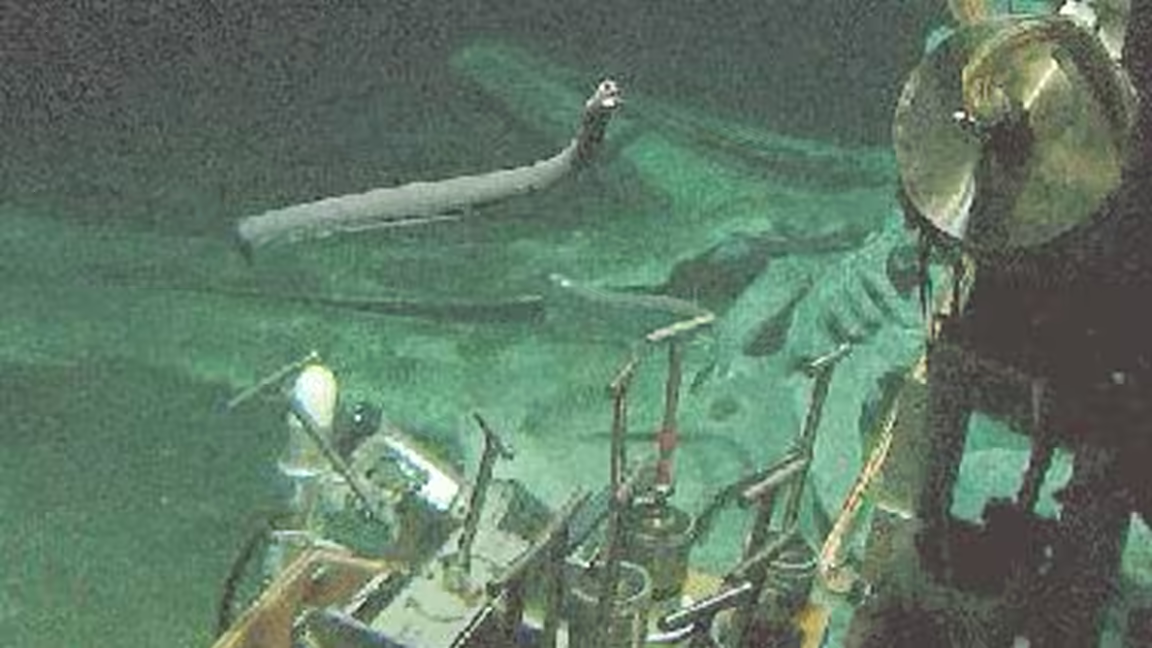
An international research team documented the deepest, oldest and most extensive known concentration of whale remains on the ocean floor, finding nearly 500 fossil and modern whale-fall sites in the Diamantina fracture zone of the south-eastern Indian Ocean.
Researchers based in China, Italy and New Zealand used the Chinese submersible Fendouzhe to explore trenches and ridges west of Australia. Across 32 dives conducted in 2023, they recorded 485 fossil sites and five recent whale falls in advanced decomposition, according to The Guardian. The findings were published in Nature on June 10, 2026.
The sites followed a roughly northwest-to-southeast corridor spanning 1,200 kilometres. Some lay as deep as 7,002 metres, far below the depth of most previously studied whale falls. The oldest sampled remains dated to about 5.3 million years ago.
The fossils included many beaked whales and a skull assigned to a newly identified extinct species, *Pterocetus diamantinae*. Researchers also found a skull from *Pterocetus benguelae*. The largest modern skeleton recorded was an Antarctic minke whale about five metres long.
Whale falls form when dead whales sink and their bodies become islands of food and habitat on the seafloor. Around the Diamantina remains, the team observed crustaceans, molluscs, bone-eating worms, brittle stars, jellyfish and other animals. Many may represent species not yet described by science. Some were related to organisms found around hydrothermal vents and cold seeps, suggesting whale remains may help connect otherwise isolated deep-sea communities.
The study proposed several explanations for the concentration but did not determine a single cause. The corridor may overlap whale feeding or migration routes, while the fracture zone's steep terrain could funnel carcasses toward deep trenches. Craig Smith, an oceanographer not involved in the study, said the fossils could improve understanding of whale evolution and distribution over geological time.
France 24 reported that the researchers extrapolated from sampled bones to suggest more than 10 million carcasses could be distributed across the broader Diamantina zone. Lead author Xiaotong Peng estimated their soft tissue and lipids could represent about 6.7 million tonnes of stored carbon. Those figures were modelled estimates for the wider area, not a direct count from the dives.
The documented sites established an exceptional research corridor rather than a complete census of the region. Scientists said future submersible missions could reveal more whale-fall concentrations elsewhere and help explain how life persists and spreads through dark, high-pressure environments.

