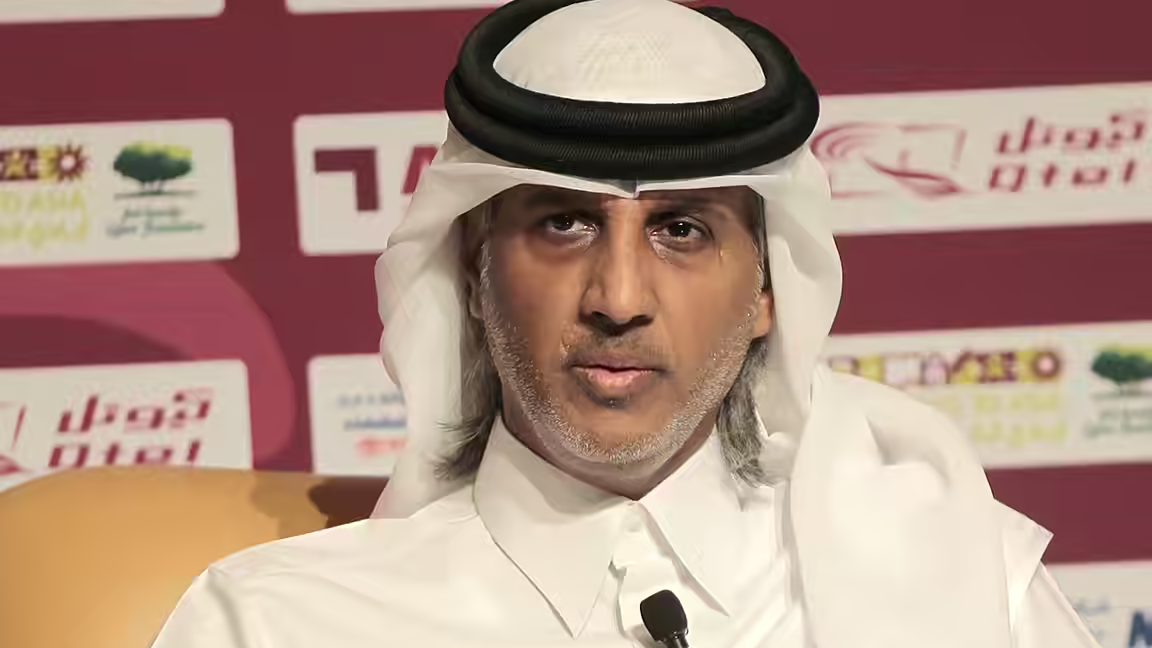
Sheikh Hamad bin Khalifa Al Thani, Qatar's former emir and a central figure in the country's modern transformation, died at 74, the government announced.
Evening funeral prayers drew thousands to the Imam Muhammad bin Abdul Wahab Mosque in Doha before his burial at Lusail Cemetery north of the capital. The emir's office mourned the man officially known as the Father Emir, while authorities ordered several days of public mourning. Government offices and public institutions closed and national flags were lowered.
Sheikh Hamad ruled from June 1995 until June 2013. He assumed power while his father was overseas in a coup that did not involve bloodshed, then voluntarily abdicated, leaving the throne to his son and successor, Sheikh Tamim. The abdication was unusual among contemporary Arab monarchies and established the succession under which Qatar continued to develop.
Born in Doha in 1952, Hamad graduated from Britain's Royal Military Academy Sandhurst in 1971. He joined Qatar's armed forces and became crown prince and defence minister in 1977. His later economic programme used the country's large natural-gas reserves to finance infrastructure, education, healthcare and investment abroad.
Qatar shipped its first liquefied natural gas in 1996 and became the world's leading LNG exporter by 2006. Asharq Al-Awsat reported that the economy measured by GDP grew to more than 24 times its earlier size during Hamad's reign and output per person rose nearly sixfold. The Qatar Investment Authority was created to place national wealth in global assets, including major companies, property and sport.
His rule also expanded Qatar's influence beyond energy. Al Jazeera began broadcasting in 1996 after an emiri decree and developed into a major Arabic-language news network. Doha adopted an active mediation policy, hosted negotiations and maintained channels with opposing regional actors. Qatar strengthened military cooperation with Washington through Al Udeid Air Base while also funding projects in Gaza.
The country secured the right in 2010 to stage the 2022 football World Cup, later becoming the first Arab and Middle Eastern host. That decision made sport another instrument of Qatar's international profile.
Condolences came from Gulf governments, Egypt, Türkiye, Italy and Britain's King Charles III, as well as Iranian, Afghan, Lebanese and Palestinian political actors. The breadth of responses reflected the varied relationships cultivated during Hamad's leadership.
His record remained connected to a highly centralised monarchy and policies that generated regional debate. Yet the scale of Qatar's economic and diplomatic change was clear: over 18 years, a small Gulf state became a major energy supplier, investor, broadcaster and mediator whose influence extended far beyond its territory. The transformation continued after his abdication.


