# Anne Carson wins 2026 Nobel Prize in Literature
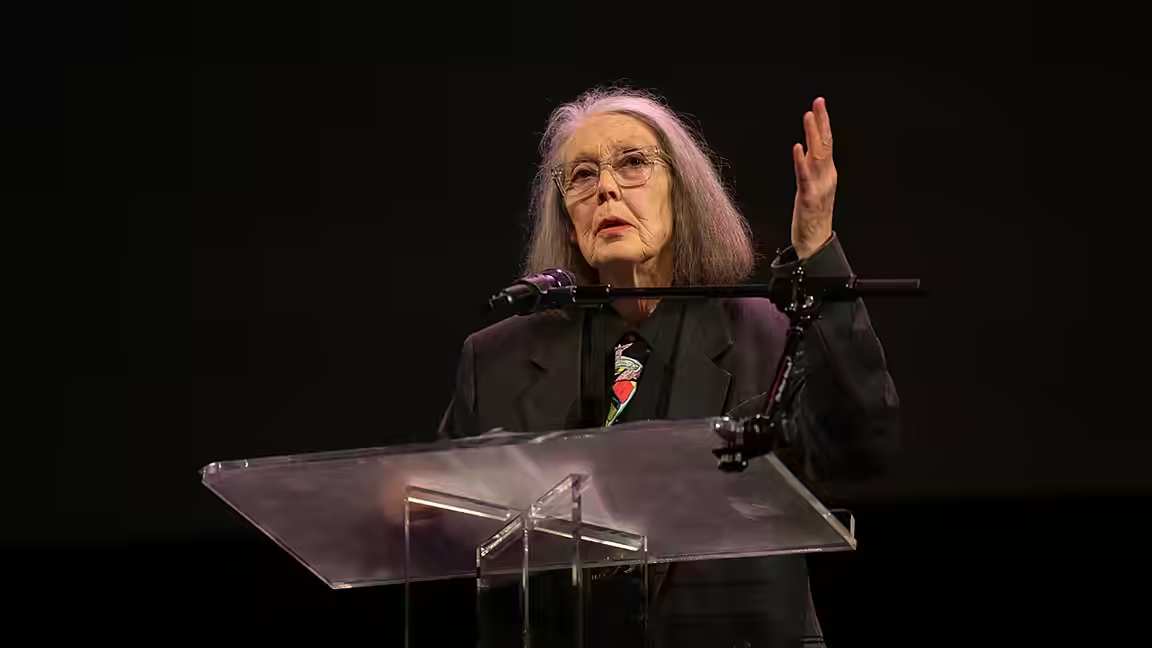
Canadian writer Anne Carson has won the 2026 Nobel Prize in Literature, receiving the world's most prominent literary award for a body of work that moves among poetry, fiction, criticism, translation and performance. The Swedish Academy cited her inventive engagement with classical traditions and her role in creating new forms for contemporary literature.
Carson, 76, was in Iceland when the academy reached her shortly before the public announcement on October 8. Permanent secretary Ingrid Carlberg said the writer was surprised and happy. Carson responded characteristically with humor, telling Icelandic broadcaster RUV that the judges were “crazy” to choose her.
The prize recognizes a career rather than a single book and carries 12 million Swedish kronor, about $1.2 million. Carson's best-known works include *The Glass Essay*, *Autobiography of Red*, *Nox*, *Float* and *The Beauty of the Husband*. Her writing frequently treats ancient Greek literature not as fixed source material but as material for experiments in voice, structure and genre.
Anders Olsson, chair of the academy's Nobel committee for literature, said Carson had moved away from lyric poetry centered on a stable narrating self. He credited her with producing playful, ironic works that travel between classical and modern poetry and between different artistic forms. Her collaborations with visual artists, choreographers, theater directors and opera makers are part of that broader practice.
Recent projects demonstrate the range. Carson's 2019 performance work *Norma Jeane Baker of Troy* connected Helen of Troy with Marilyn Monroe. In 2021 she published *The Trojan Women: A Comic*, a graphic reworking of Euripides. Her translation of Sophocles' *Elektra* was staged in London with Brie Larson in the title role. Those projects extend a career in which scholarship and translation are often inseparable from original writing.
Born in Toronto in 1950, Carson lives in Michigan and has held Icelandic citizenship since 2022. She spent more than three decades teaching classics, an academic foundation visible throughout her work. Rather than presenting ancient texts solely through explanatory scholarship, she has repeatedly placed them inside new literary objects that blur the boundary between translation, essay and poem.
Canadian Prime Minister Mark Carney called the award an extraordinary achievement and a proud moment for the country. He praised Carson's imagination and her ability to bring ancient stories to new audiences.
The Nobel consolidates international recognition that Carson has accumulated since the 1990s, while also directing new readers toward books that resist simple category labels. That resistance is central to the academy's decision: Carson's lasting contribution is not merely revisiting classical literature, but finding forms in which ancient stories, modern lives and critical thought can occupy the same work.