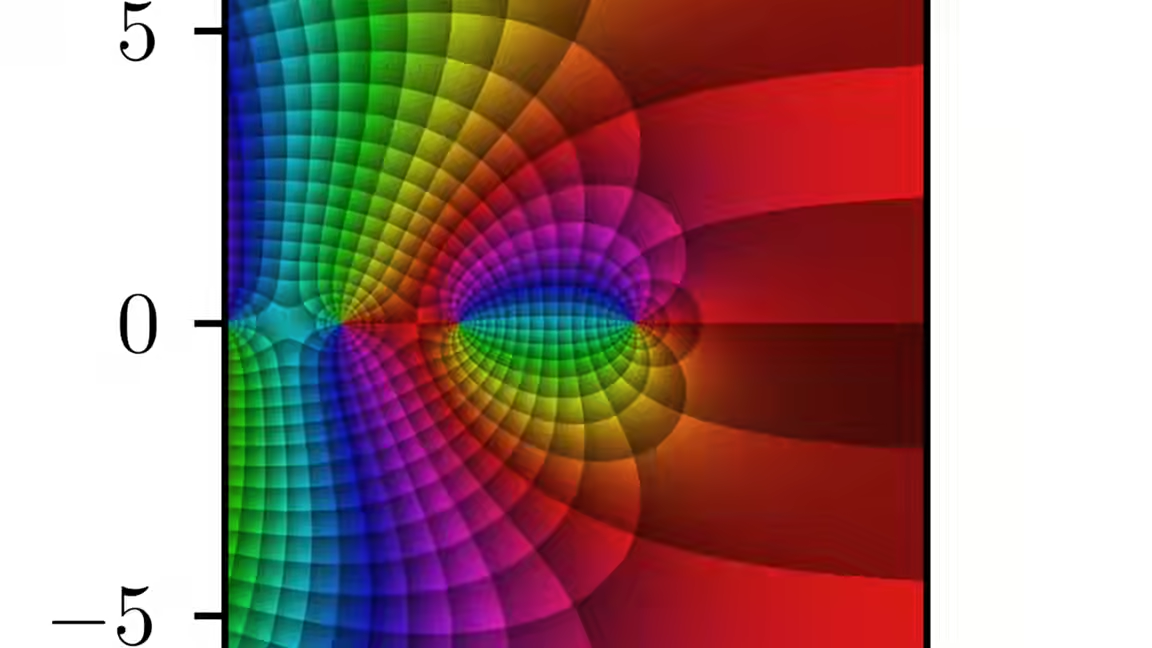
Anthropic mathematician Levent Alpöge has released what he says is an artificial-intelligence-assisted proof of the Riemann hypothesis, one of mathematics' most famous unresolved problems. The claim could be historic if it survives expert scrutiny, but it remains an unverified submission rather than an accepted solution.
Alpöge said he spent about six weeks using a non-public version of Anthropic's Claude chatbot to develop the argument. He presented the result in Lean, a programming language and proof assistant used to express mathematical statements in a form that can be checked mechanically. The complete textual output is extraordinarily large, reportedly exceeding 250,000 pages.
That scale makes verification a major undertaking even though formalization can help detect invalid logical steps. Terence Tao, a prominent mathematician, said the mathematical community's process of understanding and checking the work would take time. Having a human author available to answer questions may help reviewers navigate the construction, but it does not establish that every definition, assumption and connection to the original problem is correct.
The Riemann hypothesis, proposed nearly 170 years ago, concerns the distribution of prime numbers through the zeros of the Riemann zeta function. Its importance comes from the central role of primes in number theory and the many results that depend on the hypothesis. A valid proof would resolve one of the Clay Mathematics Institute's Millennium Prize Problems.
Alpöge announced the claim shortly after Anthropic's US stock-market debut. He acknowledged that the timing could invite skepticism and said he had contacted chief executive Dario Amodei about how to disclose the work. The coincidence does not bear on the mathematical validity, which can only be established through detailed review, but it adds a commercial context to a scientific announcement involving an unreleased company system.
Other AI laboratories have recently publicized claimed advances on difficult mathematics problems. Some have faced criticism from researchers who argue that companies use preliminary or unverified results to market the sophistication of their systems. Earlier AI-assisted claims, including work related to the Navier-Stokes equations, were still awaiting confirmation when this proof was announced.
For that reason, the responsible description is narrow: Alpöge and Anthropic have presented a claimed proof created with Claude's assistance. They have not yet demonstrated acceptance by the mathematical community. Reviewers must determine whether the formal artifact proves the standard Riemann hypothesis, whether its dependencies are sound and whether the result can be understood and reproduced.
Whatever the final verdict, the submission is a significant test of AI-assisted formal mathematics. A confirmed proof would transform number theory; a flaw would still provide evidence about where automated reasoning succeeds or fails on research at the highest level.