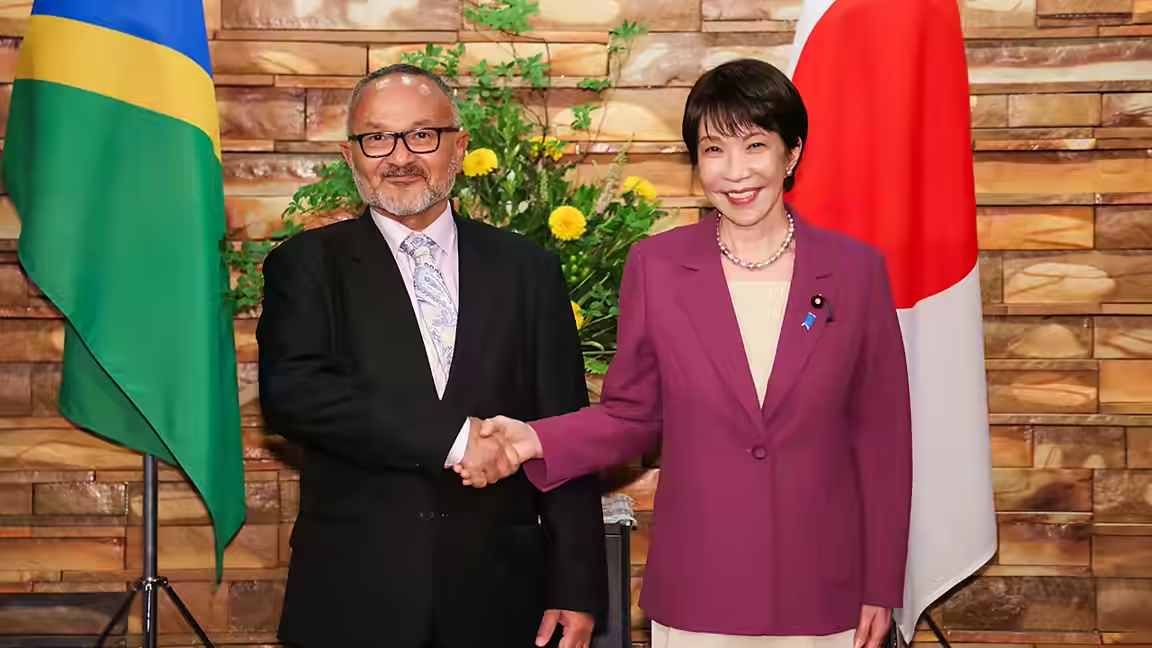
Solomon Islands Prime Minister Matthew Wale and Australian Prime Minister Anthony Albanese signed a bilateral treaty on November 25 that designates Australia as the Pacific nation's primary security partner and rules out any foreign military or security base on Solomon Islands territory.
The agreement comes amid uncertainty over a separate security pact that Solomon Islands signed with China in 2022. That earlier deal alarmed Australia and other regional governments, which feared it could eventually support a Chinese naval presence in the South Pacific. Reports have said Honiara will not renew the Chinese agreement when it expires in early 2027, but Wale declined to confirm that account because the treaty contains a non-disclosure clause.
Wale said his government remained in discussions with China. Beijing's Foreign Ministry also did not directly answer whether Solomon Islands had signalled an end to the pact. A ministry spokesperson said China's relationships with Pacific island countries were based on equality and were not intended as geopolitical rivalry.
The Australian treaty makes a clearer public commitment. A joint statement from Wale and Albanese says no foreign military or security base will be allowed in Solomon Islands, an archipelago of fewer than 900,000 people located about 2,000 kilometres northeast of Australia. Its position along sea routes between Australia and the United States gives the country strategic importance far beyond its population.
Security is only part of the new arrangement. Australia also agreed to invest in infrastructure, education, renewable energy and sport. That broader scope reflects Canberra's effort to build long-term partnerships around priorities identified by Pacific governments, not solely military access. Albanese described the relationship as stronger than at any previous point.
Australia has pursued several bilateral agreements in the region since 2022, including arrangements with Fiji, Tuvalu and Vanuatu. A 2024 pact with Papua New Guinea combined security ties with a commitment of 600 million Australian dollars over a decade to support a rugby league team entering Australia's national competition.
The new Solomon Islands treaty gives Canberra a prominent formal role, but it does not fully clarify Honiara's future relationship with Beijing. Chinese police trainers have worked in the capital under the existing agreement, and Wale's government has not publicly disclosed whether that cooperation will continue. Implementation of the Australian pact, and the fate of the China deal, will show how Solomon Islands balances competing partners while maintaining its stated ban on foreign bases.
A regional analyst at the Lowy Institute described the agreement as significant and tailored to Solomon Islands priorities. That assessment reflects its combination of security provisions and civilian investment, although the supplied report did not specify the timing or value of those investments.