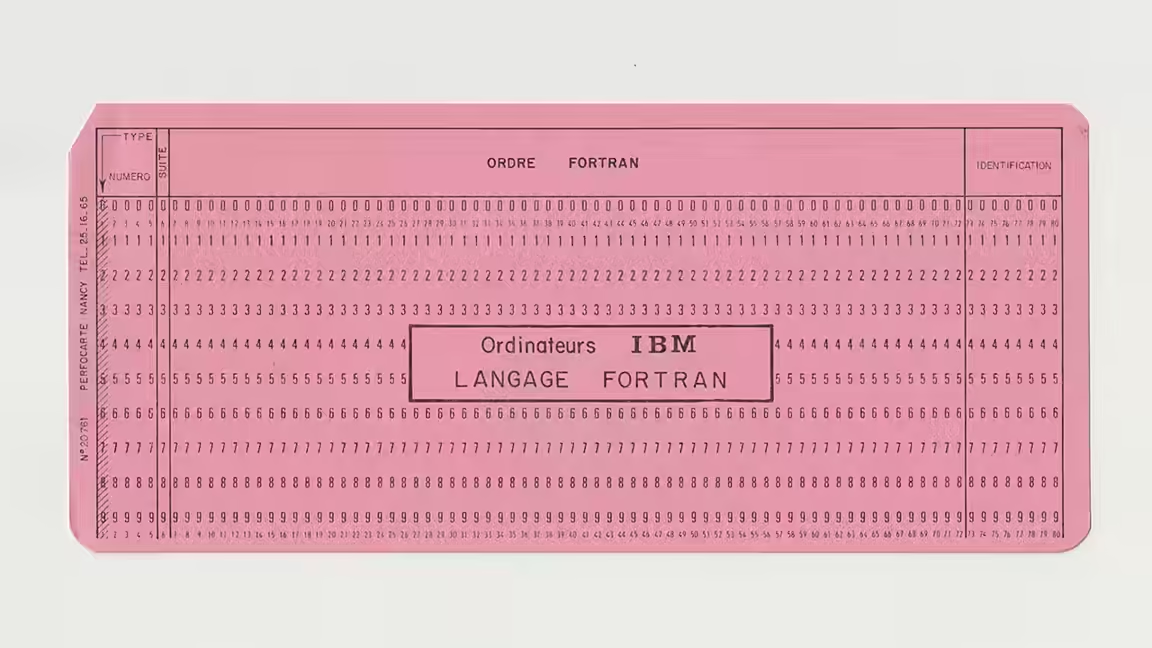
The Fortran community has marked 70 years since publication of the language's first manual, celebrating a technology that remains embedded in scientific and engineering computing. An anniversary event planned for December in Manchester will combine a historical review with discussion of current development and the language's next decades.
Fortran's longevity is closely tied to fields that require demanding numerical computation. Across seven decades, it has supported work in nuclear engineering, weather and climate forecasting, materials science and other research domains. The language continues to be used for high-performance programs in those areas, where mature code bases and parallel computing capabilities remain important.
The Institute of Computing for Climate Science will host “Celebrating 70 years of Fortran” at the Science and Industry Museum in Manchester, United Kingdom, on December 1. The main workshop is scheduled for 14:30 to 18:15 in the museum's conference suite, followed by an evening reception in the exhibition hall. That reception is expected to include a demonstration of “Baby,” the experimental computer developed in Manchester in the 1940s.
The workshop is structured as both a retrospective and a forward-looking community meeting. Damian Rouson of Lawrence Berkeley National Laboratory is due to deliver a keynote examining Fortran's development over its 70-year history. Short talks will cover active technical work and community initiatives, while an open breakout discussion will consider priorities for the next 70 years. Organizers are accepting proposals for lightning talks, posters and breakout topics.
Attendance is free because of support from funders and sponsors. AMD and Dell Technologies are listed as platinum sponsors, with CAKE, OpenMP and the Institute of Computing for Climate Science providing bronze sponsorship. Although the event is centered on an in-person gathering, organizers also plan remote participation through Zoom. Registration is due to close on November 9.
The anniversary underscores a distinctive position in software history: Fortran is old enough to trace its origins to computing's early institutional era while remaining an active tool for contemporary research. The planned program reflects both sides of that story. Museum surroundings and the demonstration of an early computer provide historical context, while presentations on present development and future needs focus on the work still being carried out in the language.
For scientists and maintainers, the anniversary is therefore more than a ceremonial milestone. It is an opportunity to compare lessons from long-lived software with the technical and organizational work required to keep scientific infrastructure useful across changing generations of hardware and researchers.