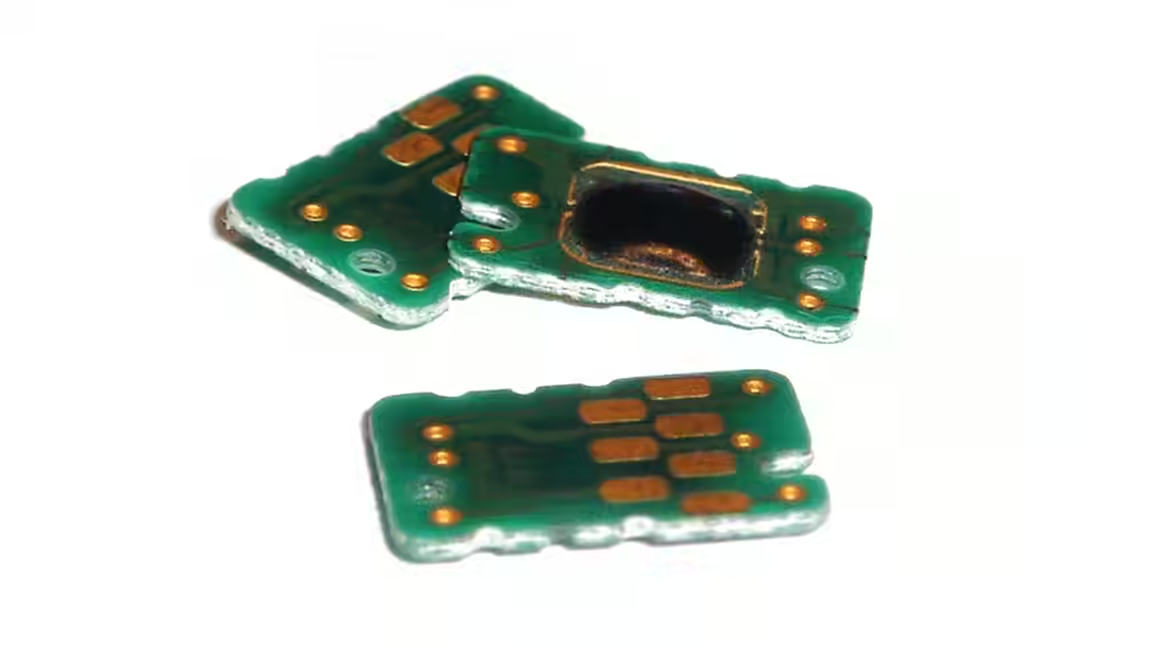
Jane Street’s reverse-engineering challenge set off a familiar kind of developer obsession: a puzzle that looked like a chip, behaved like a chip, and ultimately demanded a mix of curiosity, tooling, and stubbornness to decode. According to a write-up by the solver, the task centered on an application-specific integrated circuit, or ASIC, described through a GDS file and related artifacts that had to be understood from the ground up.
The account describes a process that moved from simple inspection to custom tooling, then back to existing documentation once the solver realized how much leverage the right file formats could provide. Early steps were manual and exploratory. The author looked for recognizable labels such as clock, reset, power, and ground references, and used those to infer how the design was laid out. A Python library able to read GDS structures became the first useful bridge between raw geometry and something resembling a circuit diagram.
From there, the work quickly became a lesson in how difficult hardware puzzles can be when they are mediated through dense data. The author says they extracted SVG representations of elements, examined text embedded in the shapes, and used overlaps in two-dimensional geometry to infer connections. That mattered because the design was large enough to make visual inspection unreliable. What helped most was not a single clever trick but the combination of signal extraction and repeated validation against the underlying files.
The write-up also shows how reverse engineering often becomes a race between discovery and distraction. The solver describes building a circuit simulator, a parser for a homemade hardware description language, a harness for testing, and even a waveform-viewing workflow before stepping back from the custom stack and returning to simpler analysis. Those detours were not the point of the story, but they illustrate the pressure that complex technical puzzles exert on engineers: when one path stalls, it is tempting to invent a new tool rather than solve the original problem directly.
Eventually, the solver found that the official Jane Street challenge materials and the available documentation for the Sky130 standard-cell ecosystem answered several unresolved questions. That documentation helped decode the role of standard logic elements and gave meaning to the design’s labels. In the account, the decisive moment came when geometry, labels, and documentation all lined up well enough to support extraction of a usable circuit model.
The broader significance of the story is less about one specific challenge than about the shape of modern technical problem-solving. Hardware puzzles are rarely solved by intuition alone. They are solved by assembling a chain of evidence from file formats, tool behavior, design conventions, and whatever public documentation exists around them. In this case, the challenge appears to have rewarded exactly that kind of methodical persistence. The solver’s month-long effort turned an opaque ASIC description into something that could be reasoned about, step by step, until the structure began to make sense.