A new theoretical analysis has placed stringent limits on the idea that exceptionally massive primordial black holes make up a meaningful share of dark matter. Researchers compared the uneven matter distribution such objects would produce with observations of the cosmic microwave background and found that the expected signature is absent.
Primordial black holes are hypothetical objects that could have formed from unusually dense regions in the early universe, unlike familiar black holes created by collapsing stars. The study focused on a proposed class sometimes called “stupendously large” black holes, with each object weighing at least 100 billion times as much as the sun. That would make them more massive than even the enormous black holes observed in the centers of galaxies.
Nicholas Leister of the Mainz Institute for Theoretical Physics and colleagues examined a basic statistical consequence of such a population. If these black holes were scattered randomly, chance alone would put more of them in some regions and fewer in others. Radiation could initially compensate for that imbalance, but the compensation would weaken as the universe expanded and radiation became less dense.
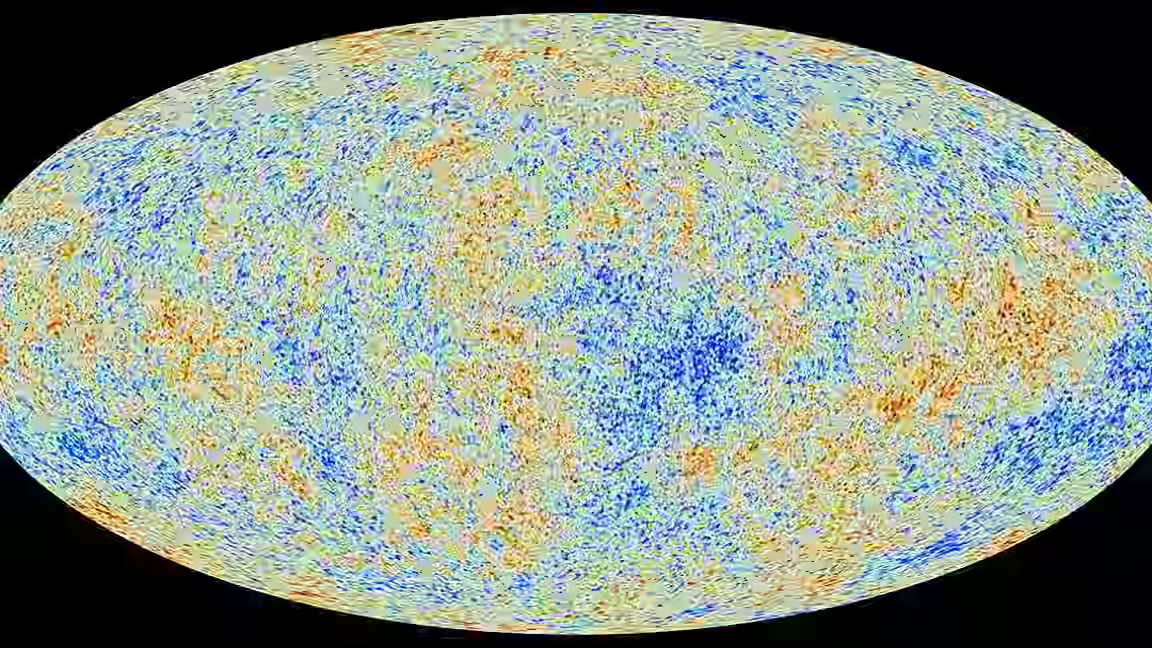
The resulting variations in the ratio of dark matter to radiation should leave patterns in the cosmic microwave background, the relic light produced in the early universe. Fewer and heavier objects would make the random distribution more uneven and the predicted signal stronger. According to the reported calculations, a population large enough to supply a substantial fraction of dark matter would create variations well beyond limits established by existing microwave-background measurements.
The result matters because dark matter is estimated to account for about 85% of the universe’s matter, while its underlying nature remains unknown. Primordial black holes have long been among the candidates considered across different mass ranges. The new work narrows one particularly extreme part of that possibility space rather than excluding primordial black holes in general.
There are also qualifications. The calculation assumed that all objects in the tested population had the same mass. A broader distribution of masses still requires study, and the analysis does not establish that no black holes of these dimensions exist. It limits how much of the dark-matter budget such a population could plausibly provide.
The finding also weakens proposals that an abundant population of very massive primordial black holes helped seed unexpectedly developed early galaxies observed with the James Webb Space Telescope. Future cosmic-microwave-background projects, including LiteBIRD and the Simons Observatory, could tighten the constraints further. The researchers also plan to investigate still heavier objects through gravitational-wave signals that their formation might have produced.
The research was published in Physical Review Letters under the title “Closing the Mass Window for Stupendously Large Black Holes.” Its conclusion is a constraint rather than a detection: current observations do not support these enormous hypothetical objects as a significant reservoir of dark matter.