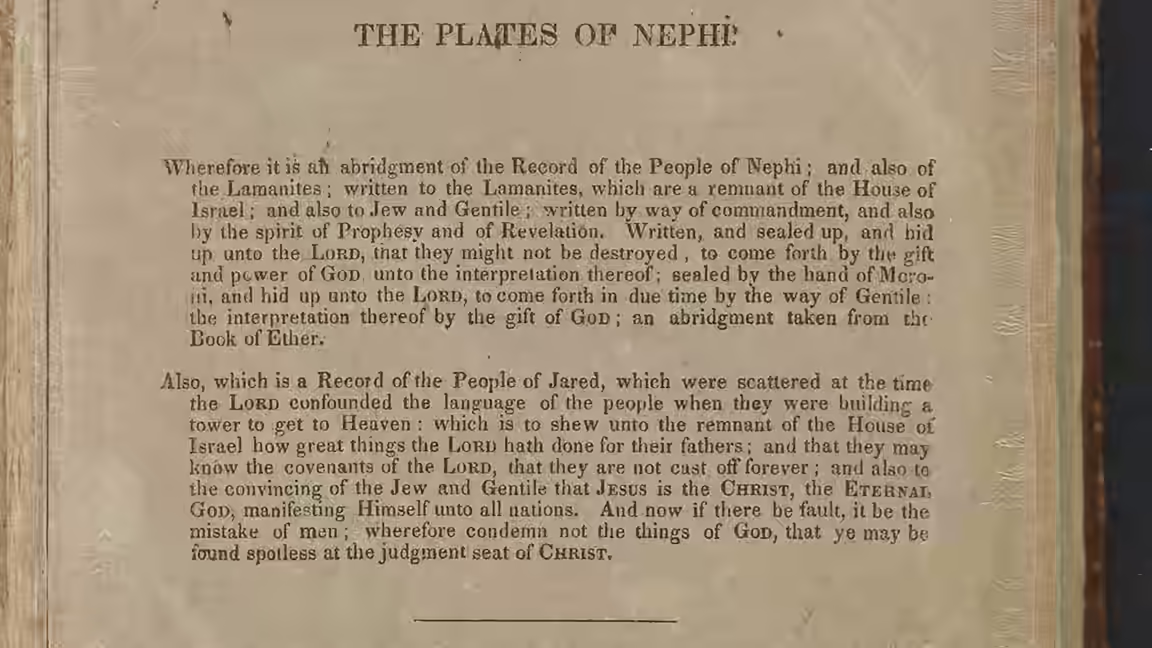
An independent computational study published on November 26 tested the 1830 Book of Mormon for textual borrowing and authorship signals using language models restricted to material available before 1830. The author says the project compared the text with work from 23,872 period authors and made its code, models and result files public for replication.
The analysis reported little direct copying. An exact-match search across 221,000 earlier books attributed 0.16% of the Book of Mormon to short, loose shared phrases spread among 30 books, rather than identifying a lifted page. The researcher also revisited claims involving Gilbert Hunt's The Late War and other works written in a mock-biblical style.
That test reproduced 183 shared rare four-word phrases for The Late War, including six not found elsewhere in the comparison library. But every one of eight other books written in the same broad style also crossed the study's borrowing threshold, and 2,044 books in the larger collection met the same criteria. The project therefore interpreted many of those overlaps as signals of genre and biblical diction rather than evidence that one named book was necessarily a source.
To reduce the influence of the King James Bible, the study masked King James wording before running its methods. That step was important because biblical phrasing is pervasive in the 1830 text; the project counted the expression “it came to pass that” 1,290 times. It also tested semantic similarity by dividing the library into 128-word passages and comparing 163 million passages, alongside a separate method that represented plot events without character names.
For authorship, the project compared eight people who have figured in historical arguments, including Joseph Smith, Oliver Cowdery, Sidney Rigdon and Solomon Spalding. Its broad result was that the Book of Mormon resembled revelations Smith dictated during the same period more than his everyday letters and journals. The researcher cautioned that this cannot distinguish common authorship from a shared religious register.
The study is not peer-reviewed research and its author explicitly disclaims scientific credentials. More importantly, the published assessment says none of its attribution methods is reliable enough at rejecting all listed candidates. Its value lies in the scale and reproducibility of the comparisons, while its own limitations prevent the results from resolving religious claims or definitively naming an author.
The project also used controls before applying its plot-comparison method to the target text. One example compared the historian Josephus’s retelling of biblical material with Genesis through Judges, checking whether matched events appeared in the same order rather than merely sharing themes or vocabulary.