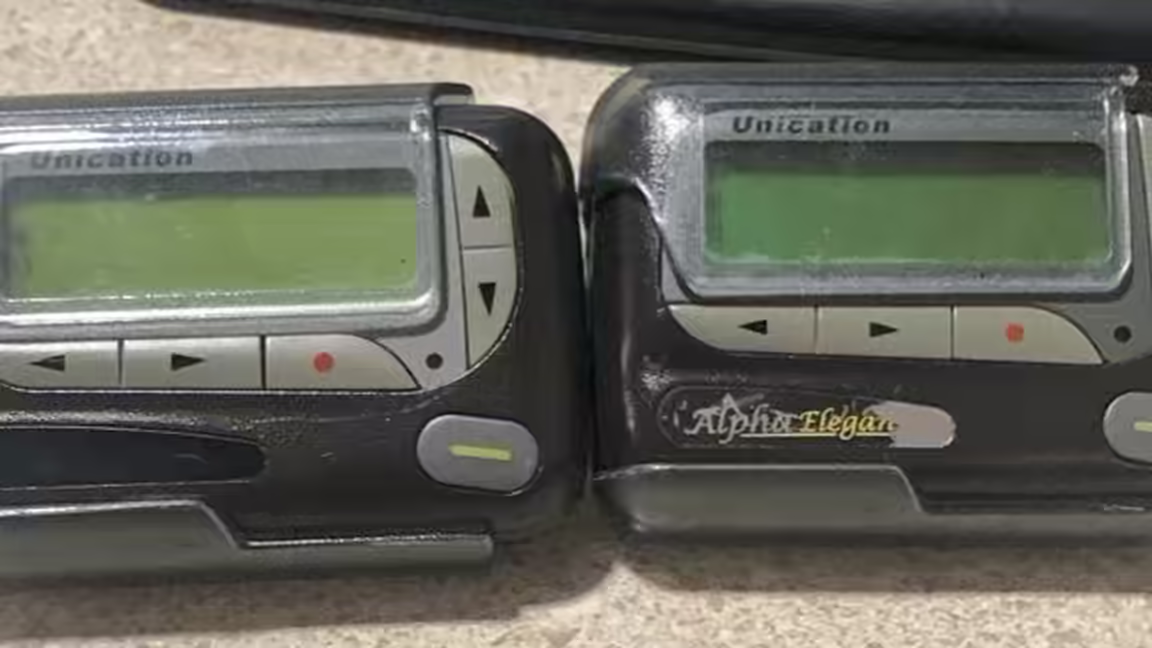
Hundreds of pagers exploded almost simultaneously in Lebanon and parts of Syria; Lebanon's health minister reported at least nine deaths and about 2,750 injuries in Lebanon. The dead included an eight-year-old girl, while more than 200 of the injured were in critical condition.
The devices were used by members of Hezbollah, the Iran-backed armed group and political movement. Hezbollah and the Lebanese government blamed Israel for the attack. Israel's military did not comment publicly on the allegation on the event date.
Explosions began at about 3:30 p.m. local time and were reported in Beirut's southern suburbs, southern Lebanon and the eastern Beqaa region, as well as Damascus. Devices detonated while people were shopping, sitting in cafes or traveling in cars and on motorcycles. Images and reporting from the scene showed wounded people being taken to hospitals as bystanders and emergency workers responded across multiple locations.
Lebanon's health minister, Firass Abiad, said many victims had wounds to their faces, hands and abdominal areas. Hospitals faced a sudden influx of patients, while blood-donation appeals were issued. Associated Press photographers reported severe injuries among people brought for treatment, illustrating how the small devices caused extensive harm when they exploded close to their users' bodies.
Hezbollah said two of its fighters and a girl were among those killed in the pager blasts. It later announced the deaths of six other members on the same day, though its statements did not specify whether all six died in the device explosions. That distinction means the overall toll and the number of confirmed Hezbollah members within it could not be fully reconciled from the supplied reports.
Iran's ambassador to Lebanon, Mojtaba Amani, was among the injured, according to Iranian media cited by both the Associated Press and Al Jazeera. The United States said it had not been involved and was gathering information. State Department spokesperson Matthew Miller said Washington did not know in advance that the incident would occur.
The synchronized nature of the blasts raised immediate questions about how the pagers had been compromised. Security analysts cited in the reporting said the operation appeared to require preparation before the devices reached their users, possibly through interference in the supply chain. On the event date, however, the evidence did not establish who installed explosives, when that happened or precisely how the detonations were triggered.
The pagers had become important to Hezbollah after its leader, Hassan Nasrallah, urged members earlier in the year to avoid smartphones because of the risk of surveillance or tracking. A Hezbollah official described the explosions as the group's most serious security breach since cross-border fighting with Israel began after October 7, 2023. The attack therefore struck not only individuals but also a communications system adopted as a security measure.
The Associated Press later reported that Taiwanese company Gold Apollo said it had licensed its brand for the AR-924 pagers, while another company, BAC, produced and sold them. That manufacturing detail emerged after the event date and should not be read as information publicly established during the first hours of the attack. The supplied evidence does not determine where in the distribution chain the devices were altered.
Hezbollah accused Israel of carrying out what it called an attack on both its personnel and civilians, and promised a response. An unnamed US official later told the Associated Press that Israel briefed Washington after the operation had concluded. Because the official was not authorized to speak publicly and Israel had not issued an on-record confirmation, the public attribution on the event date remained an allegation supported by later anonymous US reporting, not an acknowledged Israeli operation.
The explosions occurred during escalating confrontation along the Israel-Lebanon border. Hezbollah and Israeli forces had exchanged fire almost daily for nearly a year, displacing tens of thousands of residents on both sides. On the same day, Israel added the safe return of displaced northern residents to its formal war objectives. A day earlier, Israeli Defence Minister Yoav Gallant had said military action was the remaining route to achieve that goal.
Those developments intensified fears that the pager attack could widen the conflict. Unlike a conventional strike on a single site, the detonations followed device carriers into public spaces, producing casualties across a broad geographic area and creating uncertainty about who might be affected next. Al Jazeera reported widespread panic in areas where Hezbollah has a strong presence.
The attack also complicated the distinction between a targeted operation and its civilian consequences. Many users appeared to be linked to Hezbollah, but devices exploded wherever their carriers happened to be. The death of a child, the risk to people in surrounding public spaces and the strain placed on civilian hospitals showed the reach of an operation centered on personal communication equipment.
By the end of September 17, the confirmed public picture was stark but incomplete: nine people were dead, roughly 2,750 were injured, and Hezbollah's communications network had suffered a major breach. Responsibility had not been publicly acknowledged by Israel, while key technical questions about the devices and their supply chain remained unresolved.


