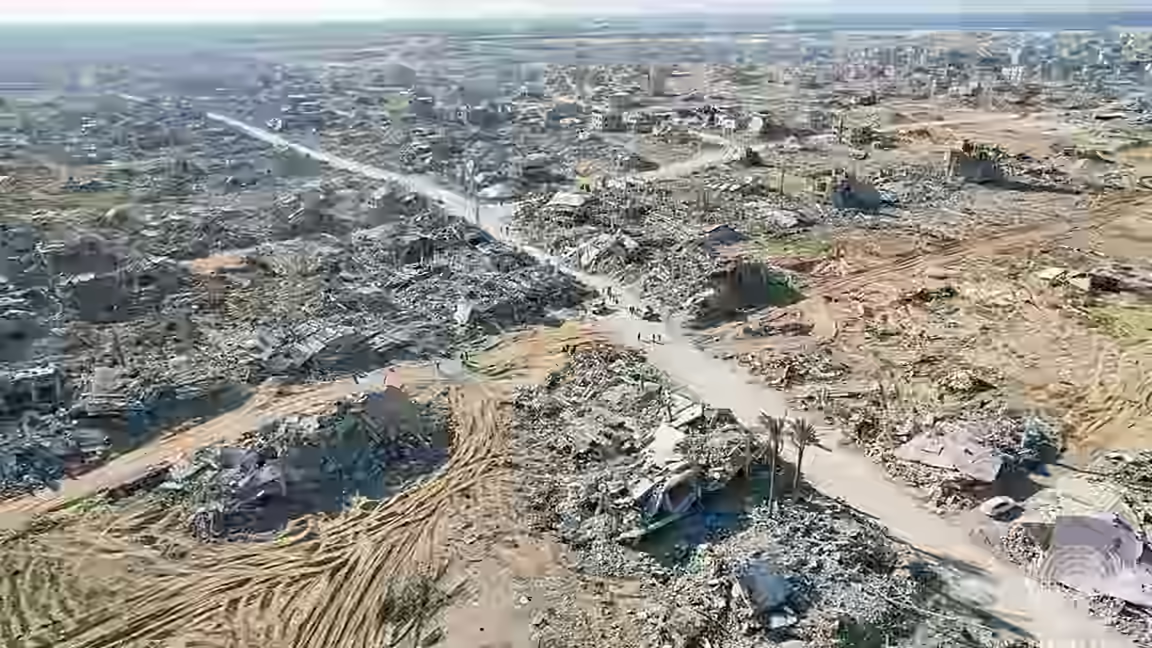
US President Donald Trump said the United States should take long-term ownership of the Gaza Strip, clear its ruins and redevelop the territory after Palestinians were permanently resettled elsewhere.
Trump announced the proposal at a White House news conference beside Israeli Prime Minister Benjamin Netanyahu. He described Gaza as a dangerous demolition site and said the United States would remove unexploded weapons, demolish damaged structures and create jobs through reconstruction. He predicted that the territory could become a regional resort and a home for people from around the world, including Palestinians.
The president gave no details about what legal authority Washington would use to acquire or occupy Gaza. He also did not rule out sending US troops, saying the government would do what was necessary. The proposal represented a sharp break from longstanding US support for a negotiated two-state solution and immediately raised questions about forcible displacement, regional stability and the future of an already fragile ceasefire.
Permanent removal presented as reconstruction
Trump argued that Palestinians had no practical alternative to leaving because Gaza had been devastated by more than 15 months of war. He said Egypt, Jordan and other countries would ultimately accept them, despite both governments having rejected earlier calls for resettlement.
The plan involved moving roughly 1.8 million people from a territory many families have inhabited for generations. Many Gazans descend from Palestinians who fled parts of present-day Israel and were never able to return, making another proposed permanent removal especially contentious. Trump did not explain how consent would be obtained, where residents would go or whether they would retain any right to return.
His remarks came as US and Arab mediators were working to extend the Israel-Hamas ceasefire, move toward a second phase and secure the release of remaining hostages. Reconstruction and increased humanitarian deliveries were already central to those negotiations. Introducing permanent resettlement and US control threatened to complicate talks based on Palestinians remaining in Gaza.
Regional allies reject displacement
Saudi Arabia responded by reaffirming that support for an independent Palestinian state was firm and by rejecting attempts to remove Palestinians from their land. The kingdom said it would not establish diplomatic relations with Israel without the creation of a Palestinian state. Egypt and Jordan had likewise warned that displacement could destabilise the region, widen the conflict and undermine the two-state framework.
Hamas official Sami Abu Zuhri described Trump’s proposal as expulsion and warned that Gaza’s population would resist it. American critics also raised concerns. Democratic lawmakers called the idea reckless and warned that a US deployment could produce a lengthy military occupation with substantial casualties.
Australian Prime Minister Anthony Albanese declined to comment directly on Trump’s remarks but reiterated his government’s support for a two-state solution. The early reactions reflected a broad diplomatic problem for the White House: countries Trump expected to host displaced Palestinians were already publicly opposed to doing so.
An announcement without an implementation path
Despite the joint appearance, the proposal remained an aspiration rather than an operational plan. No timetable, cost estimate, governing structure or congressional role was supplied. Trump did not answer how the United States could claim ownership over the territory under international law.
The reference to possible troops added another unresolved issue. Reconstruction would require security, unexploded-ordnance removal and administration on a vast scale. If carried out without the free agreement of Gaza’s residents, critics argued, the project would amount to forced displacement rather than humanitarian recovery.
The announcement nevertheless mattered because it placed a previously fringe idea at the centre of a presidential meeting with Israel’s leader. It also linked the language of real-estate development to one of the conflict’s most sensitive questions: whether Palestinians would be able to remain on their land after the war.
As of February 4, the White House had presented no concrete mechanism for US ownership, no agreement from regional states to receive Gaza’s population and no indication that Palestinians had consented. The immediate result was therefore not a change in Gaza’s status, but a major shift in the terms of American political debate while ceasefire negotiations were still under way.


