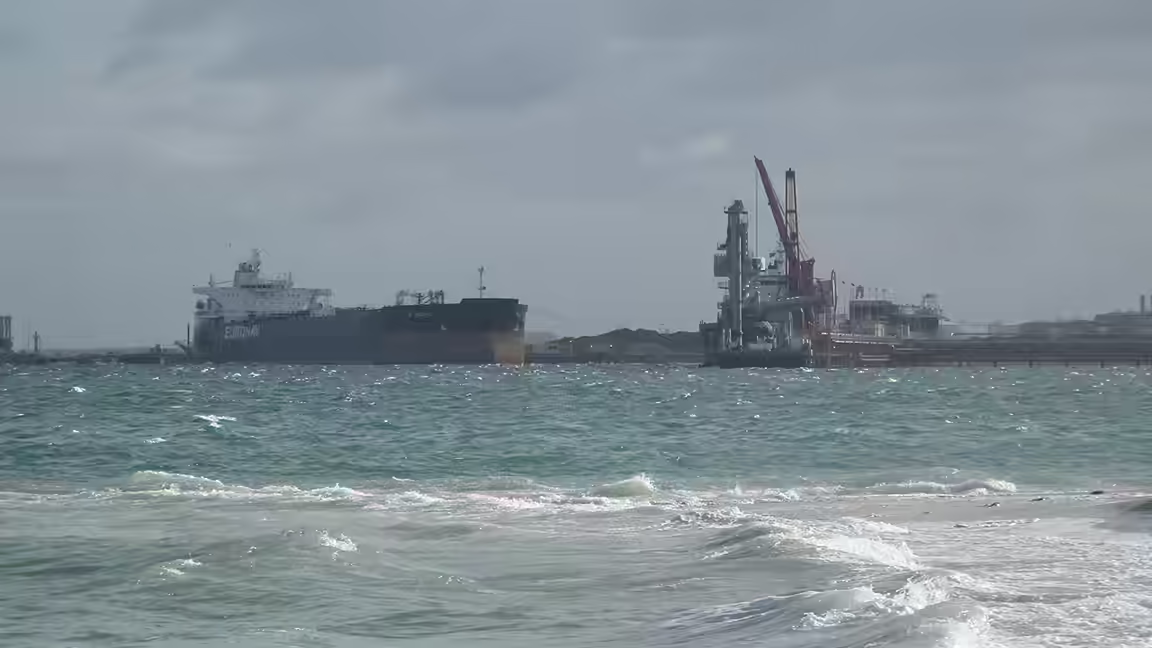
Australia has deployed a Royal Australian Air Force P-8A Poseidon maritime patrol aircraft to Kadena Air Base in Okinawa to monitor North Korea’s illicit maritime activity.
The evidence packet, citing Japan’s foreign ministry and NK News, says the deployment began in late March and was aimed at tracking activities that help fund North Korea’s weapons of mass destruction programmes in violation of United Nations sanctions. That makes the move part of a wider regional effort to watch the sea lanes and ship-to-ship behaviour that have long been used to obscure sanctions evasion.
The event date is March 31, 2025. The timing is relevant because surveillance deployments of this kind are often brief, rotational and tied to a particular enforcement window. Here, the verified fact is that Australia put an aircraft into Okinawa-based operations to support monitoring of North Korean maritime activity.
The report is narrow but clear on the purpose. It does not say the aircraft was intercepting vessels, making arrests or directly enforcing sanctions at sea. Instead, it was a monitoring mission, which is an important distinction. Observation supports enforcement by building the evidence picture, but it is not the same as a kinetic or interdiction operation.
That distinction also helps explain why the deployment matters regionally. North Korea has relied on evasion tactics across maritime routes for years, and allied surveillance has become one of the main tools for detecting them. A long-range patrol aircraft such as the P-8A is well suited to that role because it can cover large distances and gather information across open water.
The presence of an Australian aircraft in Japan also underscores the multinational character of sanctions enforcement. This is not a purely bilateral Australia-North Korea issue. It sits inside a network of Japanese, Australian and wider allied monitoring around North Korean shipping and logistics.
The packet does not give the number of sorties, the duration of the deployment or the specific intelligence products generated by the aircraft. It also does not suggest any immediate incident at sea. So the best account is straightforward: Australia deployed a surveillance aircraft, the mission was based at Kadena, and the stated purpose was to monitor North Korean illicit maritime activity tied to sanctions evasion.
For Tokyo and Canberra, the deployment is part of the steady machinery of deterrence and enforcement. For Pyongyang, it is another reminder that its maritime supply lines are under persistent watch. And for the wider region, it shows how security around North Korea increasingly depends on long-range surveillance rather than only visible naval presence.


