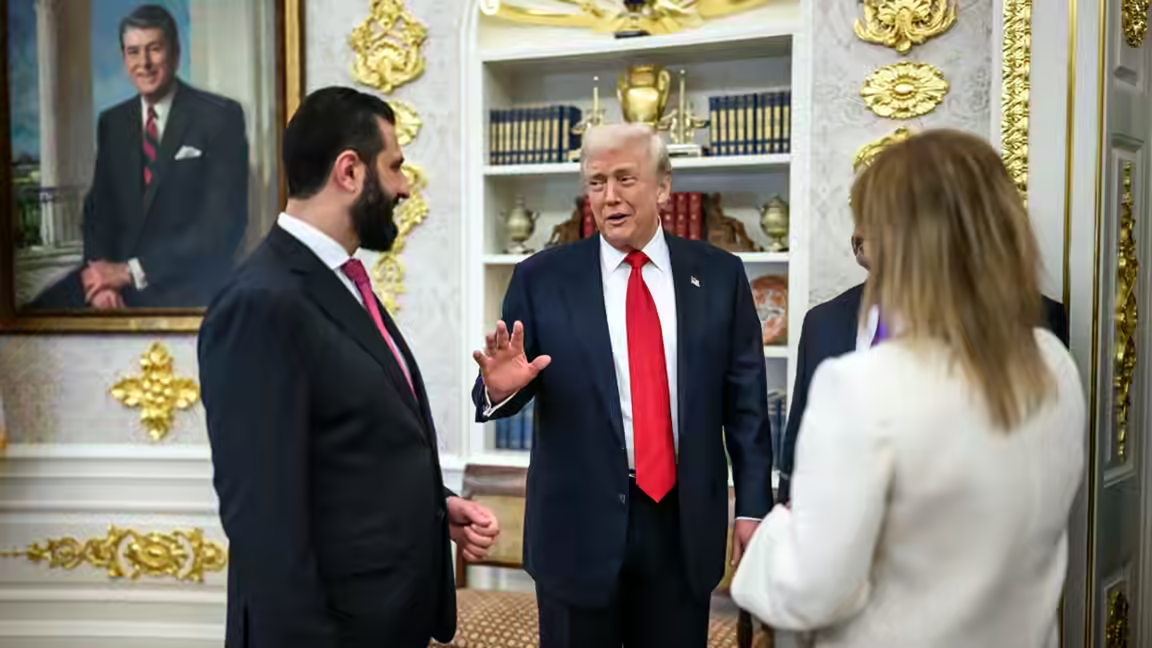
US President Donald Trump sharply criticised both Israel and Iran on June 24 after reported exchanges threatened a ceasefire intended to halt 12 days of conflict. He accused both sides of breaching the arrangement, reserved his strongest criticism for Israel and demanded that Israeli aircraft be recalled.
The truce had been announced the previous evening, hours after Iran fired missiles at a US military base in Qatar in retaliation for American strikes on three Iranian nuclear facilities. By Tuesday morning, Israel and Iran were each accusing the other of violating the ceasefire, creating uncertainty over whether the agreement would survive its first hours.
Speaking to reporters at the White House, Trump said Iran had violated the deal but that Israel had done so as well. He complained that Israel had launched an exceptionally heavy round of bombing after the agreement was reached and said he was unhappy with both governments. In a profane assessment, he said the two countries had fought for so long that they no longer knew what they were doing.
Pressure on Israel
Trump’s intervention went beyond public criticism. In a message posted on Truth Social, he instructed Israel not to release additional bombs, called any such attack a major violation and told the country to bring its pilots home.
The Guardian reported that Trump also spoke by telephone with Israeli Prime Minister Benjamin Netanyahu and pressed him to scale down a planned strike. Trump subsequently said Israeli aircraft would turn back and that the ceasefire remained in effect. Explosions were nevertheless reported around Tehran and northern Iran shortly afterward, leaving the precise sequence and extent of the response unclear in the contemporaneous reporting.
Israel said Iran had broken the truce first by launching two ballistic missiles toward northern Israel around two and a half hours after hostilities were due to stop. Trump described the incident as involving one rocket that might have been launched by mistake and did not land. Iran’s account and the competing military claims could not be independently resolved from the evidence supplied for this article.
Trump focused particular anger on the scale of Israel’s intended retaliation. His comments represented an unusually direct public rebuke of a close US ally at a moment when Washington was trying to preserve a deal it had helped arrange. UK Prime Minister Keir Starmer also urged both countries to return to and observe the ceasefire.
Truce begins to hold
Despite the accusations and reported explosions, the ceasefire appeared to be holding by Tuesday evening. Both Israel and Iran acknowledged that the arrangement was in place. Netanyahu later described the outcome as a historic victory for Israel, while Iranian President Masoud Pezeshkian said the Iranian people had brought the 12-day war to an end. Those statements reflected each government’s political framing rather than a shared assessment of the conflict.
The precarious truce followed direct US military involvement. American B-2 bombers had attacked the Fordow, Natanz and Esfahan nuclear sites over the preceding weekend. Trump and Defense Secretary Pete Hegseth presented the operation as having destroyed Iran’s nuclear capabilities. However, reporting on June 24 cited a preliminary Defense Intelligence Agency assessment that the strikes had not destroyed the programme and may have delayed it by only months. The White House rejected that assessment as wrong.
That intelligence dispute was separate from the immediate ceasefire violations, but it complicated claims of a decisive conclusion. It also formed part of the wider political pressure surrounding Trump as he travelled to a NATO summit in the Netherlands.
By the end of the event date, the central development was not that the ceasefire had failed, but that it had come close to doing so. Reported launches, planned retaliation and fierce accusations tested the arrangement almost immediately. Direct US pressure on Israel helped limit the response, according to the supplied reporting, and the absence of a renewed large-scale exchange allowed the truce to settle into place—at least temporarily.


