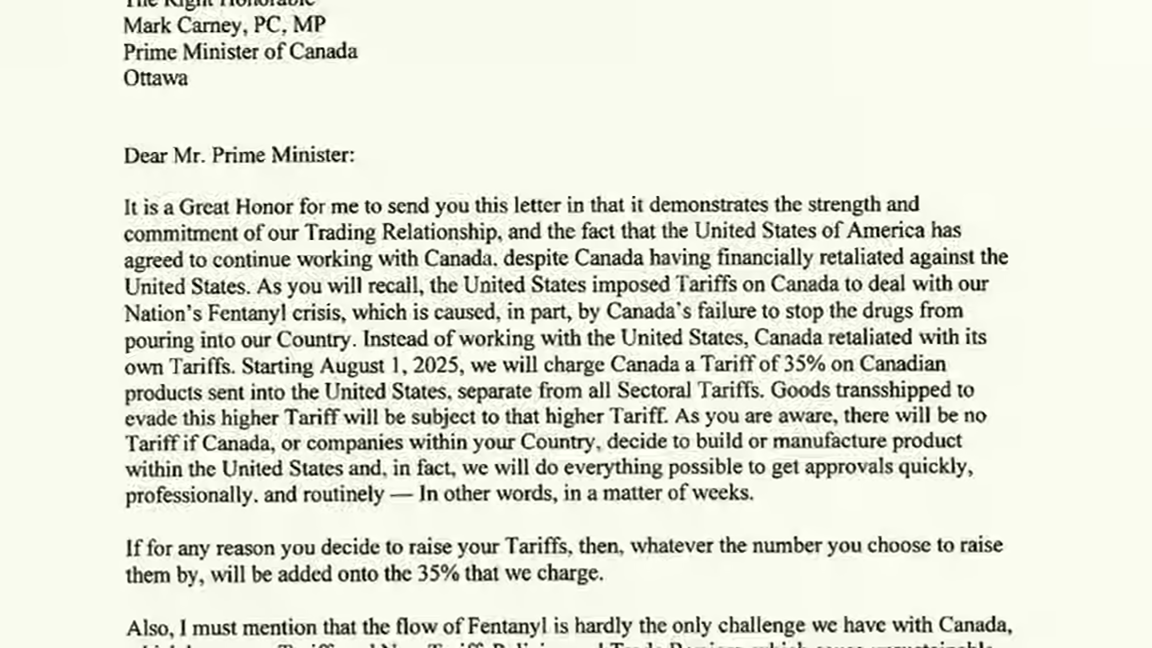
US President Donald Trump has abruptly suspended trade talks with Canada and said his administration will announce new tariffs on goods crossing the border within seven days, escalating a dispute that had been moving toward a mid-July deadline for a broader deal.
Trump said on social media that all trade discussions were over “effective immediately” because of Canada’s digital services tax, which he called an “egregious tax” on technology companies. The Canadian levy, set at 3%, has been a flashpoint in the relationship for months and the first payments are due on Monday. Canadian officials had been expecting to address the issue as part of trade negotiations.
The move introduces fresh uncertainty into a relationship that is already under strain from earlier tariff rounds. The United States is Canada’s largest trade partner, taking in more than $400bn in goods last year under a longstanding free trade arrangement, but Trump has repeatedly used tariffs as leverage in efforts to reshape trade ties and reduce deficits. Earlier this year, his administration imposed a 25% tariff on Canadian goods, citing border security and drug-trafficking concerns, and it has also levied duties on cars, steel and aluminium.
Trump’s latest remarks came as the two countries were working toward a deal by mid-July. At the G7 earlier this month, Trump and Canadian Prime Minister Mark Carney set a 30-day target for an agreement. Carney responded more cautiously, telling reporters that Canada would keep negotiating in the national interest. The BBC reported that the talks may continue despite the president’s threat, even if the political temperature has risen sharply.
The dispute has a major corporate dimension as well. Business groups estimate the Canadian digital services tax could cost American companies such as Amazon, Apple and Google more than $2bn a year. That helps explain why business leaders in Canada and the United States have pressed Ottawa either to soften the tax or remove it entirely if negotiations are to stay on track.
Trump’s comments also landed in the middle of broader uncertainty around his tariff strategy. He has threatened major trading partners before, then pulled back after extracting concessions or creating room for last-minute bargaining. The BBC noted that he recently threatened higher tariffs on the European Union before relenting a few days later. That pattern has left businesses and governments trying to judge whether the new threat is a final break or another pressure tactic.
The Canadian debate is not only about market access but also about how digital platforms should be taxed in a cross-border economy. Ottawa’s levy is meant to capture revenue from large online businesses that profit from Canadian users, while Washington has long argued such taxes unfairly target U.S. firms. That disagreement now sits at the center of a wider trade fight.
Still, the immediate effect is clear. Trade talks that had been framed as advancing toward a summer deadline are now in doubt, and Canadian officials face a fresh choice: keep the digital tax in place and absorb the fallout, or find a way to reset talks before higher tariffs arrive. For now, Trump has made the dispute larger, faster-moving and more public, with the border itself once again the leverage point in a dispute over technology policy, tax revenue and the future of North American trade.


