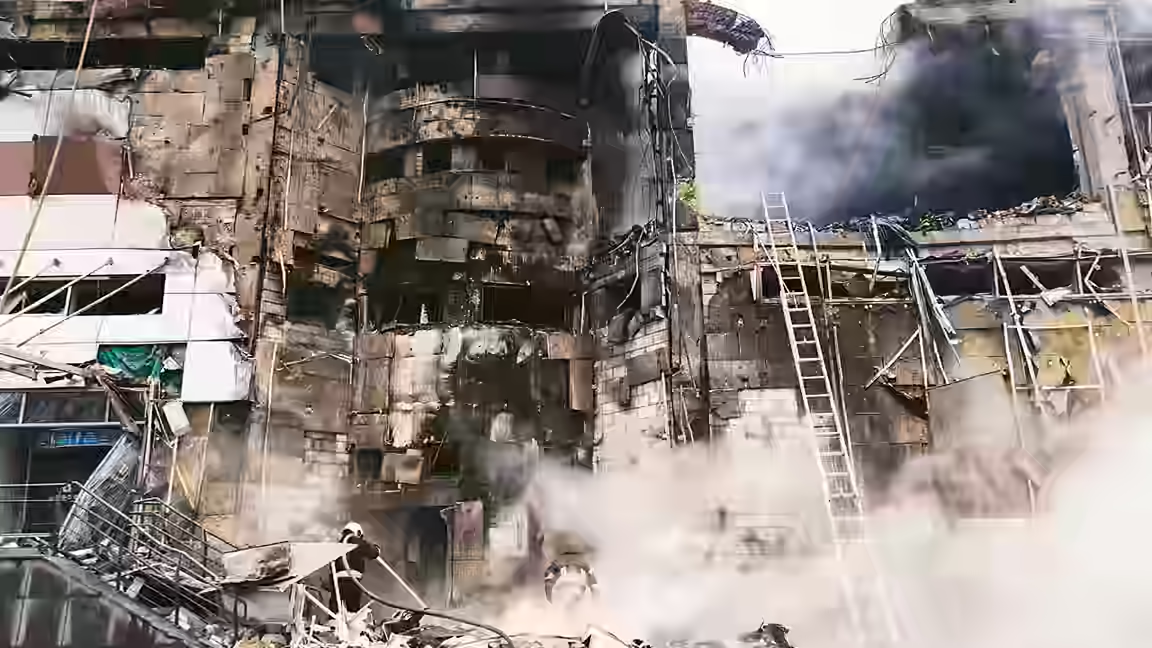
On August 11, Ukrainian forces said Russian troops had opened a full-scale push in the Dobropillia direction, adding pressure to an already fragile front line north of Pokrovsk in Donetsk oblast.
The account came from Ukrainian Armed Forces officer Andriy Tkachuk, who described the battlefield as increasingly unstable and said Russian units had penetrated Ukrainian defenses enough to create a "gray zone." In his description, the new push was not an isolated probe but part of a broader effort to deepen the Russian advance across a sector already under strain.
Tkachuk said the situation around Pokrovsk remained especially difficult because Russian forces were fighting for Rodynske, a settlement north of the city that helps anchor logistics toward Dobropillia, Myrnohrad and Pokrovsk itself. He described Rodynske as an important junction for supply lines and said losing it would complicate one of the routes Ukrainian forces use to sustain the defense.
He also said the Defense Forces still relied on three logistics chains into Pokrovsk. One route runs through Pavlohrad and, in his telling, remains relatively stable. A second goes through Hryshyne to the northwest. The third runs north through Rodynske, where Russian troops were trying to gain a foothold near the Krasnyi Lyman mine. That fighting, he said, was continuing even as Ukrainian units worked to stop further advances.
The officer framed the Dobropillia axis as a separate and evolving threat, saying Russian forces were developing a new offensive direction there while wedging deeper into Ukrainian lines. He also said Russian units were trying to break through toward Pokrovsk with small sabotage groups in the southwest of the city.
Tkachuk pointed to one example from late July, saying 150 Russian servicemen advanced from Selydove toward the outskirts of Pokrovsk, but only 30 reached the city itself within 10 days. He said most of the rest surrendered or were eliminated. That figure was presented as part of a wider picture in which Russian assaults were costly, but still persistent enough to keep pressure on the front.
The remarks underline how much of eastern Ukraine’s fighting now revolves around roads, mines and transport corridors rather than single front lines. By Tkachuk’s account, the Russian push toward Dobropillia is aimed not only at territorial gains but at reshaping the logistics map around Pokrovsk, where every route matters and every village can carry strategic weight.
The picture Tkachuk painted also explains why the fighting around the north of Pokrovsk is so sensitive. In his account, Russian forces are not simply pressing the line at one point; they are trying to turn villages, mines and crossroads into pressure points that can force Ukrainian units to spend manpower on defense and supply protection at the same time. The mention of the Krasnyi Lyman mine matters in that context because industrial sites often become both terrain and cover in wartime, giving attackers and defenders a fixed point around which to organize fire and movement.
The broader battle also shows the strain of trying to hold multiple axes at once. If one route remains relatively stable while another comes under threat, commanders still have to protect the overall logistics network. Tkachuk’s comments suggest Ukrainian forces are trying to do exactly that while also containing small Russian sabotage groups south and southwest of Pokrovsk. The result is a fight in which territorial gains, supply lines and attrition are all linked, and where even a limited Russian advance can force a wider operational response from Kyiv’s troops.


