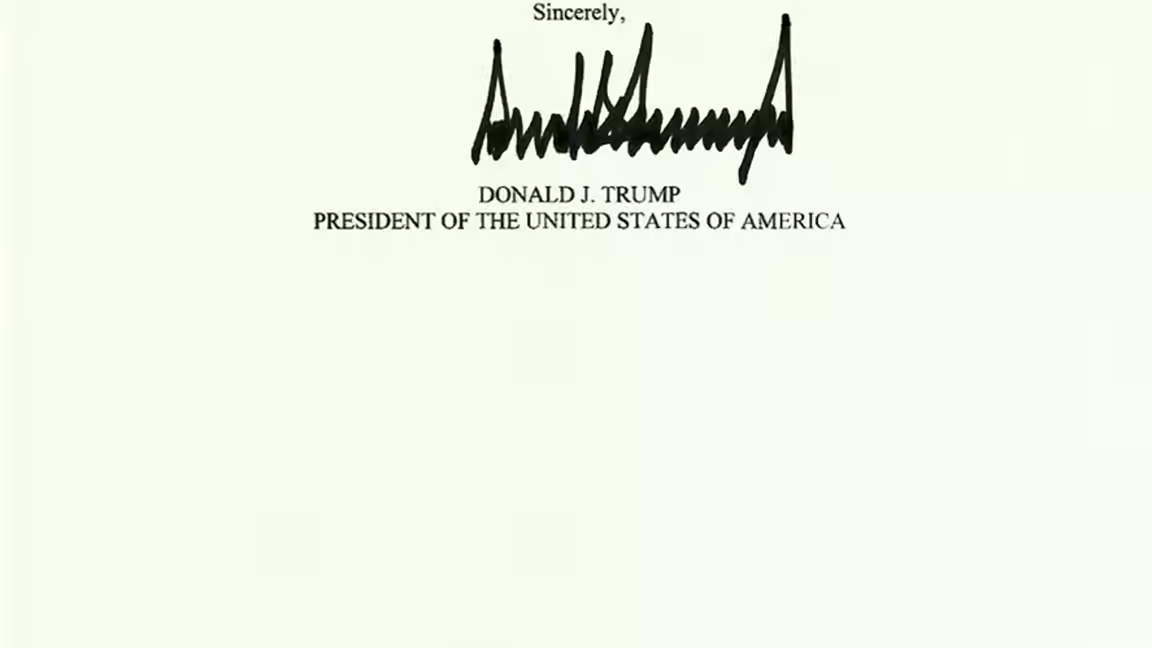
Donald Trump said he would raise US tariffs on Canada by 10% after an anti-tariff advertisement sponsored by the Ontario government angered him. The announcement, posted on Truth Social, escalated an already tense trade dispute between the two countries and linked the tariff increase directly to the content of the ad.
The evidence said the advertisement referenced Ronald Reagan's support for free trade, which the White House viewed as a serious misrepresentation. Trump framed the tariff increase as retaliation, turning a communications dispute into a policy action with immediate economic implications. The statement added further strain to one of the world's largest trade partnerships, where cross-border commerce is deeply embedded in both economies.
The move also showed how quickly the administration was willing to translate public irritation into trade measures. Rather than treating the Ontario ad as a minor political irritant, Trump used it to justify a sharper tariff stance. That link between messaging and tariff policy leaves businesses and provincial officials facing more uncertainty about how the dispute could affect goods flowing across the border.
The evidence does not provide details on the exact products that would be affected by the 10% increase, nor does it describe any Canadian response. What it does make clear is that the White House presented the tariff hike as a direct answer to the Ontario campaign, with Trump accusing the province of distorting the free-trade position associated with Reagan. The result was a fresh flashpoint in an already sensitive economic relationship.
The tariff increase turns a communications fight into an economic one. By responding to a provincial advertisement with a federal trade action, Trump linked political messaging directly to border policy. That is significant because tariffs affect exporters, importers, and consumers far beyond the dispute itself. Even if the rise is framed as a penalty for Ontario, the practical effect would spread through supply chains that depend on predictable access to the Canadian market.
The episode also shows how quickly trade policy can be used as a lever in domestic and cross-border politics. The Ontario ad referenced Reagan's free-trade arguments, a choice that clearly aimed to challenge anti-tariff thinking, but it also provoked a direct presidential response. The evidence does not describe any Canadian reaction, yet it is reasonable to expect that business groups and provincial officials will see the announcement as another sign that tariff policy can change suddenly when political grievances become personal.
No breakdown of the affected goods was given, so the commercial effect remains unclear. Still, a 10% increase announced in retaliation is enough to unsettle traders who rely on stable cross-border terms.
The episode shows how quickly a political advertisement can spill into trade policy when leaders use tariffs as leverage. That uncertainty may now hang over the bilateral relationship as both sides decide how hard to push back.
The dispute now shifts from an ad campaign to a tariff question, which is where the economic consequences will be felt. Businesses on both sides of the border will now be watching for the practical details.


