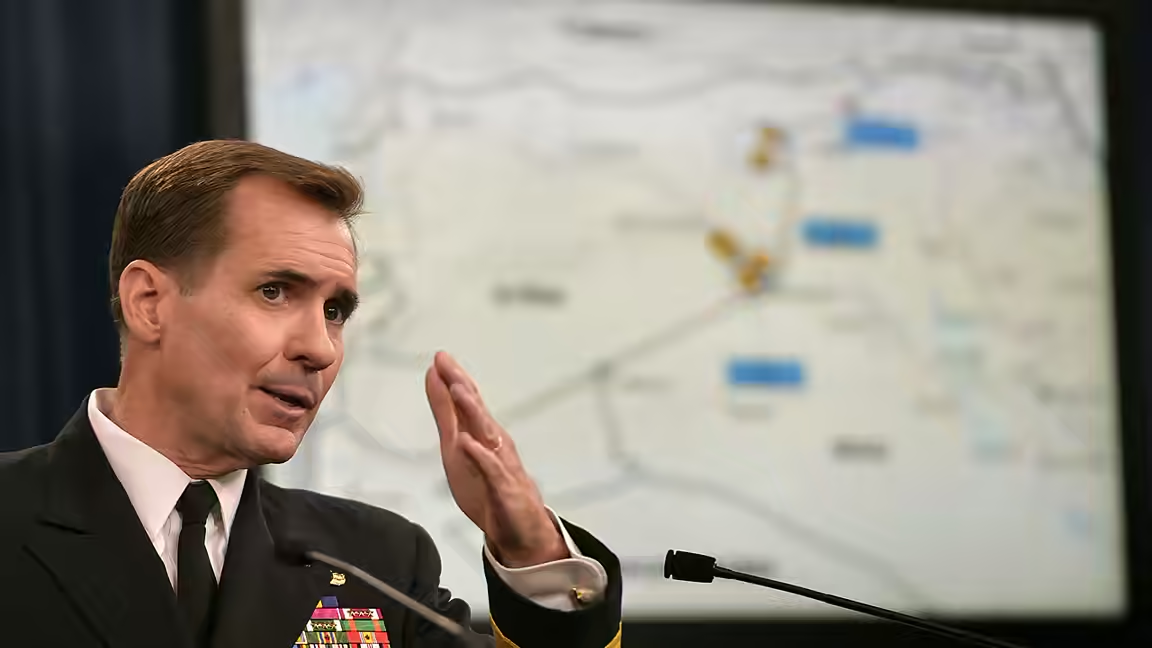
The United States and Jordan have carried out airstrikes on 70 Islamic State targets across Syria in response to the December 2025 Palmyra attack, according to the BBC.
The strikes are a reminder that, despite the collapse of the group’s territorial caliphate, Islamic State remains capable of inspiring or directing attacks that trigger large-scale military retaliation. In this case, the target set was broad: 70 sites at multiple locations in Syria.
The BBC says the action was framed as retaliation for the Palmyra attack, which had been attributed to Islamic State. That link matters because it suggests the operation was not just pre-emptive, but also punitive, intended to impose costs on the network believed responsible.
Joint US-Jordanian operations in Syria also have wider significance. They show that the campaign against Islamic State still relies on regional partners and not only on American airpower. Jordan’s involvement underscores the threat the group continues to pose to states bordering the Syrian conflict zone.
The BBC excerpt does not list the full damage assessment, but the scale of the strikes suggests a deliberate attempt to hit infrastructure, storage sites or other nodes rather than a single isolated cell. When such a large number of targets is included, the objective is often to degrade operational capacity as well as send a deterrent signal.
These kinds of strikes also carry political weight. They can reassure domestic audiences that governments are responding decisively, while also reminding militant groups that attacks will be answered across borders if necessary.
The broader Syrian context remains unstable, and Islamic State cells continue to exploit gaps in security, shifting alliances and territory that is difficult to police. Even when the group loses ground, it can preserve enough mobility and network discipline to threaten local and regional security.
The BBC account places the new strikes within a cycle of attack and retaliation that has defined the post-caliphate period. Rather than ending the conflict with Islamic State, the loss of its statelet turned it into a dispersed insurgent threat, still capable of provoking international military action.
For Syria, that means the war remains layered. Old front lines, foreign intervention, militant remnants and regional retaliation continue to overlap. The latest airstrikes are one more example of how quickly a local attack can draw in outside powers when it is seen as part of the same transnational threat.
The central fact is straightforward: 70 Islamic State targets were hit by US and Jordanian forces, and the operation was explicitly tied to revenge for the Palmyra attack. What remains to be seen is whether the strikes materially weaken the group’s networks or simply mark another turn in a long-running cycle of violence.


