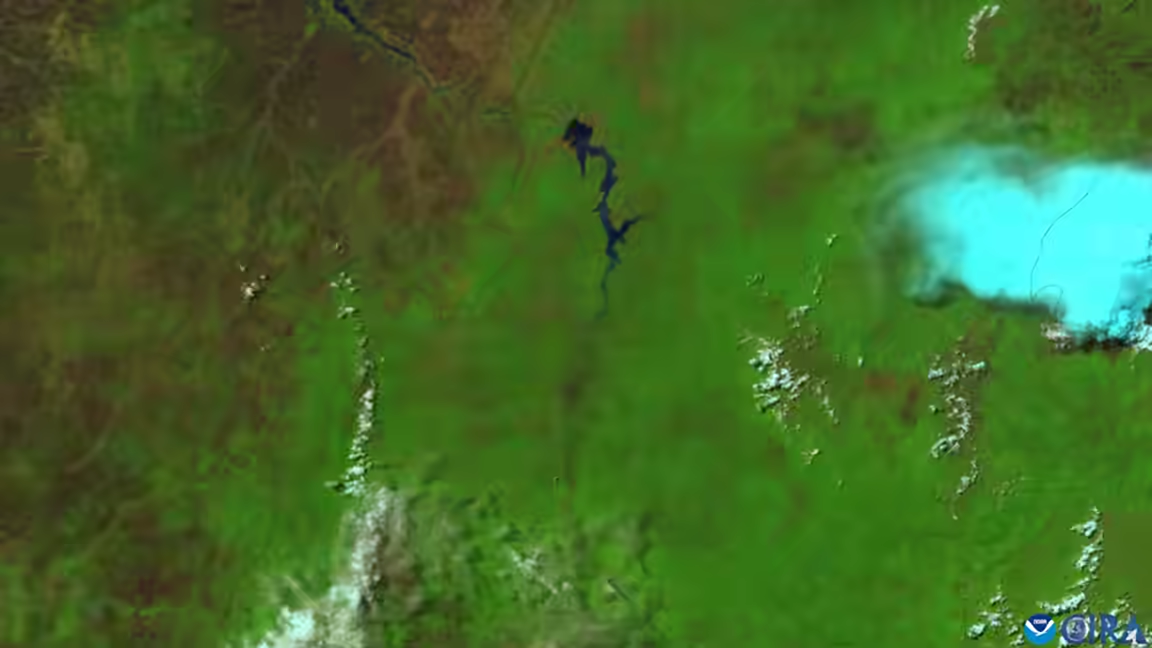
Clashes between Ethiopian federal government troops and Tigrayan forces erupted in Tigray on 2026-01-29, according to the Al Jazeera report in the packet.
The fighting is already affecting civilian life. The report says the violence has triggered the suspension of flights, with security and diplomatic sources describing the situation as deteriorating. Hostilities broke out in recent days in Tsemlet, western Tigray, an area also claimed by forces from neighboring Amhara region.
That geography matters because Tigray remains deeply scarred by the war that began in 2020 and killed thousands while displacing millions before ending in 2022. The current violence therefore lands in a region that is already impoverished and heavily dependent on humanitarian assistance.
The Al Jazeera report also links the renewed fighting to broader aid shortfalls. It says USAID cuts under the Trump administration have reduced support in Ethiopia, once the largest recipient of USAID funds in sub-Saharan Africa. In Tigray, humanitarian organizations say up to 80 percent of the population needs emergency support.
Those funding gaps have real consequences on the ground. Joshua Eckley of Doctors without Borders told Al Jazeera before the latest fighting that donor cuts had put additional strain on an already fragile health system and reduced access to medical care, water and sanitation. The packet frames the new clashes as landing on top of those pre-existing pressures.
The central verified fact is the outbreak of combat between federal and Tigrayan forces. The immediate implications are security disruption, possible displacement and more strain on humanitarian operations. For a region that has already endured a devastating war, even a limited flare-up risks reopening old fault lines and deepening an emergency that never fully disappeared.
The humanitarian context is what makes the renewed violence more dangerous. Tigray is still dealing with the aftermath of a war that displaced millions, and the report says aid cuts have already left a large share of the population needing emergency support. New clashes therefore arrive in a region with little resilience.
That combination of conflict and reduced assistance makes every battlefield shift more consequential. Suspension of flights is an immediate sign that even limited fighting can disrupt access, while the strain on health, water and sanitation systems suggests civilians may feel the impact quickly. The military and political dimensions are obvious, but the human costs may be faster to appear.
What the evidence does not show is just as important as what it does. The report does not prove a decisive territorial shift or a permanent military outcome. It does, however, show that the conflict remains active, that civilian services are being strained, and that the region’s recovery remains fragile. That makes the renewed clashes politically and humanly significant even before any new front line is drawn.
The humanitarian strain also means the return of violence can have immediate secondary effects that are easy to overlook in battlefield summaries. Health facilities, water systems and aid pipelines can be disrupted even when the fighting appears localized. That makes the clashes significant not only for territorial control but for the survival of daily life in a region already exhausted by war.
The war’s human toll is what makes each new clash more consequential than a simple map change. Tigray’s population is already described in the packet as dependent on emergency support, and the aid cuts mean there is less cushion if the fighting spreads. In that setting, any renewed hostilities can quickly become both a military and humanitarian emergency.


