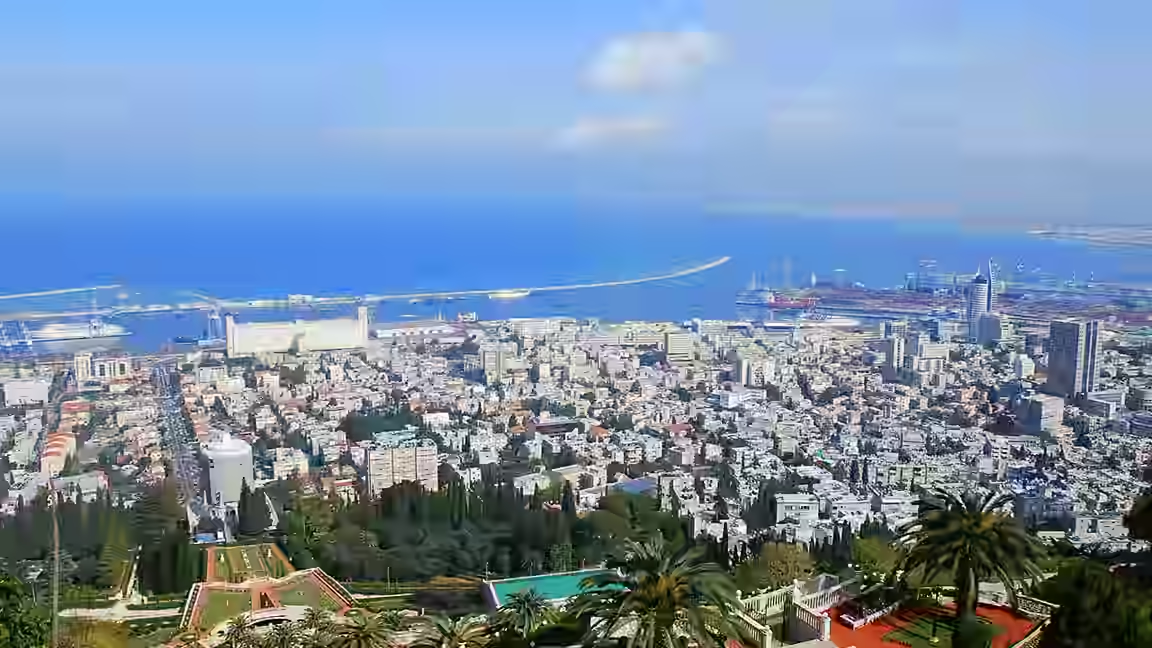
Hezbollah launched a rocket and drone attack toward a military base near Haifa in northern Israel on March 2, and Israel responded with air strikes in Beirut, southern Lebanon and the Bekaa Valley. Lebanon’s state-run National News Agency reported that 31 people were killed and 149 injured in the Israeli attacks.
The exchange marked a sharp escalation after months in which Hezbollah had largely refrained from responding to repeated Israeli strikes in Lebanon. It also pulled the country more deeply into a regional conflict involving Iran, Israel and the United States, even as Lebanon’s government sought to distance itself from Hezbollah’s decision.
Hezbollah enters the widening fight
Hezbollah said its operation targeted a military base in Haifa with rockets and drones. The Iran-aligned group described the attack as retaliation for the killing of Iranian Supreme Leader Ayatollah Ali Khamenei, as well as a response to Israeli military action in Lebanon. It argued that continued attacks and Israel’s presence in Lebanese territory gave it a right to respond.
The available reporting does not establish the scale of damage at the Israeli base. Al Jazeera’s account focuses on the launch and the subsequent Israeli response rather than confirming casualties or destruction at the intended target.
Hezbollah’s decision represented a departure from the restraint it had shown after the November 2024 ceasefire with Israel. The group had previously called on the Lebanese government to address Israeli operations through diplomatic pressure. By firing toward northern Israel, it reopened a direct exchange that exposed Lebanon to a much larger military response.
Strikes in Beirut and beyond
Israeli aircraft struck the southern suburbs of Beirut shortly after Hezbollah’s attack. Additional strikes were reported in villages across southern Lebanon and in the eastern Bekaa Valley. The Israeli military said it was conducting a broad campaign against Hezbollah and later said it had targeted senior members of the group in Beirut and another important figure in southern Lebanon, without identifying them in the supplied report.
Lebanon’s National News Agency put the toll at 31 dead and 149 wounded on March 2. That is the supported casualty figure in the supplied evidence; the higher number in the event discovery note is not independently established by these sources and is therefore omitted.
Israel also issued evacuation instructions covering more than 50 villages and towns in southern and eastern Lebanon, telling residents to move at least one kilometer away from specified buildings. The breadth of the warnings raised the prospect of substantial displacement in communities already affected by years of economic crisis and repeated conflict.
Israeli Defence Minister Israel Katz said Hezbollah would pay a heavy price and publicly threatened the group’s secretary-general, Naim Qassem. The Israeli military placed responsibility for the escalation on Hezbollah, saying it would not permit the organization to threaten northern Israel. Those statements reflected Israel’s position and did not resolve the competing claims over earlier ceasefire violations.
Beirut rejects Hezbollah’s decision
Lebanese Prime Minister Nawaf Salam condemned the Hezbollah attack as irresponsible and said it endangered Lebanon by providing Israel with a pretext for further military action. He pledged that the government would take measures to identify those responsible and prevent the country from being drawn into another war.
The statement underscored the distinction between Hezbollah and the Lebanese state. Hezbollah maintains its own armed structure and makes military decisions outside the government’s chain of command. Lebanon’s government had issued a decree calling for the group’s disarmament, but Hezbollah rejected it, arguing that its weapons were needed to defend the country.
That dispute gained urgency after the March 2 exchange. The government faced the immediate consequences of strikes and displacement while lacking direct control over the action that triggered Israel’s response. Hezbollah, meanwhile, framed its attack as both support for Iran and defense of Lebanon.
A ceasefire under strain
Israel and Hezbollah reached a ceasefire in November 2024 after a war that severely weakened the group and killed much of its senior military and political leadership. According to the supplied Al Jazeera report, Israel continued to strike inside Lebanon after the agreement. Beirut filed a complaint with the United Nations in January documenting what it said were 2,036 Israeli violations of Lebanese sovereignty during the final three months of 2025.
The parties therefore entered March 2 with fundamentally different views of the truce. Hezbollah portrayed its launch as a delayed response to continuing Israeli aggression and occupation. Israel characterized it as Hezbollah joining a regional campaign and threatening civilians in the north. Lebanon’s government treated the launch as an unauthorized act that placed the country at greater risk.
The resulting strikes showed how quickly a disputed ceasefire could unravel when linked to a broader war. Hezbollah’s military capacity was believed to be diminished after the 2024 fighting, but even a limited launch was enough to trigger attacks across several Lebanese regions.
Later developments clarify the regional scope
The BBC’s live reporting from March 3 provides later context rather than evidence available at the moment of the March 2 exchange. It said Israel detected additional projectiles from Lebanon while Israeli strikes continued to target Hezbollah. Israel reported that those projectiles were intercepted and that there were no immediate casualties.
The same later coverage described simultaneous attacks and alerts across Iran, Israel, Lebanon and Gulf states, illustrating that the Lebanon exchange had become one front in a much larger confrontation. That regional context helps explain the intensity of Israel’s response and Hezbollah’s decision to invoke the killing of Iran’s supreme leader, but it should not be backdated as information confirmed on March 2.
For Lebanon, the immediate outcome was clear: a Hezbollah attack aimed at an Israeli military site was followed by Israeli strikes in Beirut, southern Lebanon and the Bekaa Valley that killed 31 people and wounded 149, according to Lebanon’s state-run National News Agency, generated large evacuation warnings and deepened the confrontation between Hezbollah and the government in Beirut. Whether the exchange would remain limited was uncertain at the end of the event date, but the continued launches and strikes documented on March 3 showed that the escalation had not ended overnight.


