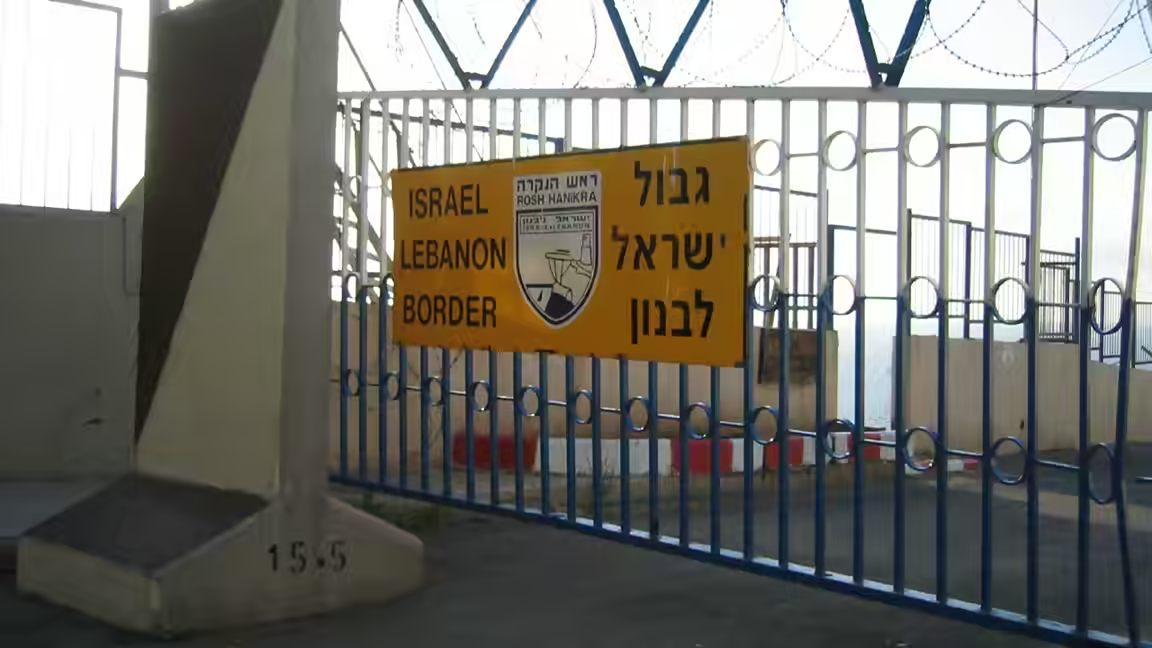
Israel said on April 8 that a newly announced ceasefire between the United States and Iran did not apply to its military campaign in Lebanon, contradicting Pakistan’s description of a wider agreement. The Trump administration also said Lebanon was outside the deal.
Israeli Prime Minister Benjamin Netanyahu welcomed the US decision to suspend attacks on Iran and backed President Donald Trump’s efforts to contain threats from Tehran. In a statement posted online, however, Netanyahu said the two-week ceasefire did not include Lebanon. White House press secretary Karoline Leavitt separately gave the same interpretation in Washington.
Pakistani Prime Minister Shehbaz Sharif, whose government had helped mediate, had announced that the United States, Iran and their allies agreed to an immediate ceasefire “everywhere,” specifically including Lebanon. The supplied evidence does not include the ceasefire text or a direct Iranian statement resolving the contradiction. It therefore remained unclear whether the parties had accepted different terms or were publicly interpreting the same arrangement in incompatible ways.
Heavy strikes across Lebanon
Israel continued attacking Lebanon after the Iran truce was announced. Air strikes hit Beirut’s southern suburbs, southern Lebanon and the eastern Bekaa Valley. The Lebanese Health Ministry reported at least 182 people killed and 890 wounded in the wave, warning that the toll could rise as emergency crews searched damaged buildings.
Israel described the operation as its largest wave of air strikes in the conflict. Its military said it hit more than 100 Hezbollah command centres and military sites within 10 minutes. Those target descriptions were Israeli claims; the supplied reports also documented extensive casualties and damage in populated areas but did not provide an independent assessment of every site struck.
Lebanon’s National News Agency reported an Israeli attack on Srifa in the Tyre region and an evacuation warning for a nearby building. The Lebanese army urged displaced residents not to return to southern towns and villages, citing continued Israeli attacks and the danger around areas where Israeli forces had advanced.
Hezbollah had not claimed a new attack after the US-Iran agreement was announced. It said it retained the right to respond and told displaced families to wait for a formal ceasefire announcement before returning. Lebanon’s presidency said it would keep working to bring the country within a regional peace arrangement.
A separate front remains active
The renewed Israel-Hezbollah war had intensified on March 2, when Hezbollah fired at Israel after the killing of Iranian Supreme Leader Ayatollah Ali Khamenei during the opening phase of the wider regional conflict. Hezbollah also cited continuing Israeli operations in Lebanon despite a November 2024 ceasefire. Israel subsequently expanded its ground presence in southern Lebanon, saying it sought a security buffer and the destruction of Hezbollah infrastructure.
By April 8, Lebanon’s Health Ministry said the war had killed more than 1,700 people, including at least 130 children, without separating fighters from civilians. Israel said it had killed about 1,100 Hezbollah fighters. More than 1.2 million people had been displaced, placing further pressure on shelters and communities across Lebanon. Each figure came from a party or authority involved in the conflict and could not be independently reconciled from the supplied evidence.
Lebanon had offered direct negotiations with Israel despite the absence of diplomatic relations, according to the BBC, but Israel had not accepted the proposal. The government in Beirut also faced a domestic dispute over a plan to disarm Hezbollah, which the group had refused to discuss.
The competing ceasefire announcements therefore had immediate consequences. Pakistan presented the pause as regional, while Israel and Washington defined it as limited to the US-Iran confrontation. Continued Israeli strikes, a rising Lebanese casualty toll and warnings against returning home demonstrated that, whatever broader diplomatic process had begun, fighting in Lebanon had not stopped on the event date.


