# Iran Reviews New US Proposal as Pakistan Steps Up Shuttle Diplomacy
*Event date: 2026-05-20*
By IO Digest Desk
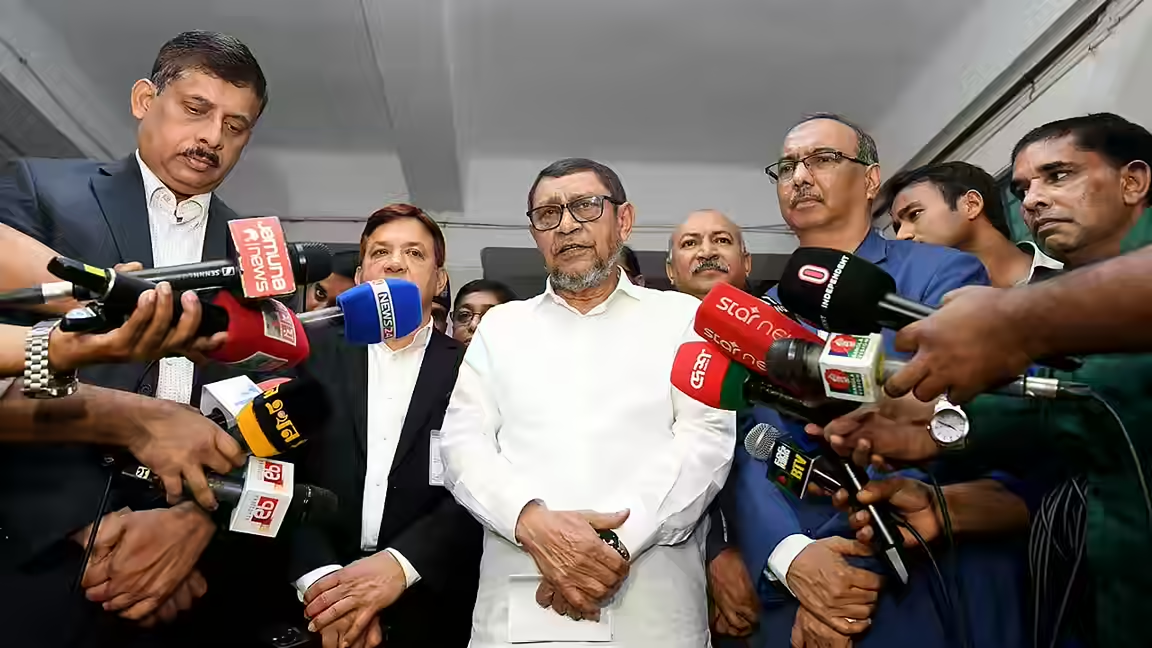
Iran said on May 20, 2026 that it had received a new proposal from the United States and was examining it, while Pakistan intensified its mediation campaign by sending Interior Minister Mohsin Naqvi to Tehran for another round of talks with senior Iranian officials.
Arab News Pakistan, citing Iranian state media and AFP, reported that Naqvi met Iranian President Masoud Pezeshkian and Interior Minister Eskandar Momeni after arriving in Tehran. The visit was presented as part of Islamabad’s ongoing effort to broker peace amid renewed tensions between Washington and Tehran. It was Naqvi’s second trip to Iran within five days, underlining the urgency Pakistan attaches to the talks.
Iranian Foreign Ministry spokesperson Esmaeil Baqaei said Tehran had received the American side’s views and was reviewing them. He also said Naqvi’s visit was intended to help facilitate message exchanges. Those two details, taken together, show that diplomacy had not completely broken down even as both sides remained far apart on key demands.
The article places the diplomacy inside a wider regional emergency. It says the war began after joint U.S.-Israeli strikes on Tehran on February 28 and that Iranian retaliation disrupted the Strait of Hormuz, through which roughly one-fifth of the world’s oil and gas passes. Although a ceasefire announced on April 8 was still holding, the report said negotiations had largely stalled after an initial round of direct talks in Islamabad.
The sticking points remained substantial. The article said disputes over Iran’s uranium-enrichment program and control of the Strait of Hormuz were still obstructing progress. Baqaei also reiterated Iranian demands that included the release of frozen Iranian assets and an end to the U.S. blockade on Iranian ports. Those conditions indicate that the talks were not just about halting combat but about restructuring broader pressure points that had built up during the conflict.
The diplomatic push also unfolded under explicit military warnings. Arab News reported that U.S. President Donald Trump had signaled Washington could resume strikes within days if no agreement was reached. Iran’s Revolutionary Guards responded by warning that any new American or Israeli attack would trigger a much wider regional war. Foreign Minister Abbas Araghchi reinforced the message by warning on social media that a return to war would contain “many more surprises.”
Pakistan, meanwhile, continued to cast itself as a stabilizing intermediary. Officials said Islamabad remained in touch with regional and international partners and was still working to prevent escalation in the Gulf. Foreign ministry spokesperson Tahir Andrabi was quoted earlier as saying the diplomatic clock had not stopped and that the peace process was still functioning.
That combination of shuttle diplomacy, proposal review and mutual threats captures the unstable balance of the moment. The ceasefire had not collapsed, but neither had it matured into a dependable settlement framework. Instead, mediation depended on repeated in-person contacts, message carrying and the hope that both sides still saw more value in bargaining than in renewed strikes.
The verifiable facts therefore point to a narrow but real diplomatic opening: Iran had a new U.S. proposal in hand, Pakistan was actively carrying messages, and the region remained poised between negotiation and another round of war.


