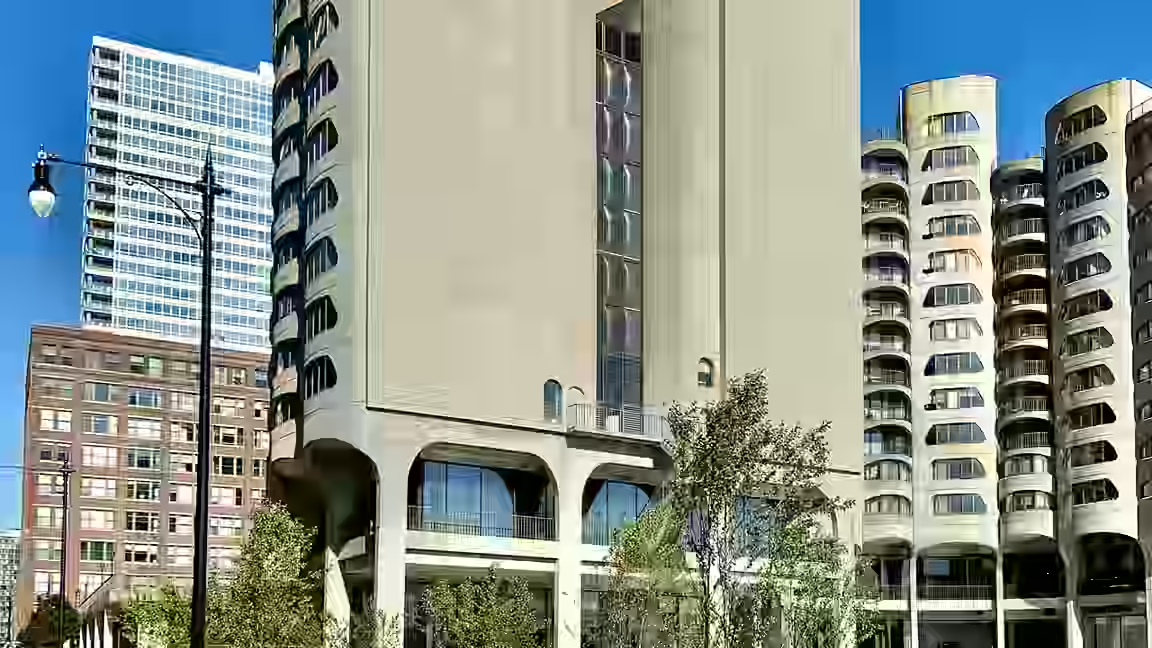
US opens new consulate in Nuuk as Greenland tensions grow
The United States has opened a new consulate in Nuuk, strengthening its presence in Greenland at a time of renewed political tension over the island’s future.
The supplied Politico report says the inauguration took place at a new 3,000-square-metre complex in Nuuk’s city centre. The opening followed a visit from U.S. special envoy to Greenland Jeff Landry and came as the White House sharpened its focus on the Arctic.
The move is diplomatically sensitive because it lands in the middle of broader debate about Greenland’s strategic value and the Trump administration’s repeated interest in the island. The article says President Donald Trump has floated the idea of annexing Greenland and, at one point, did not rule out military force. Those comments have generated concern in Denmark and among Greenlanders.
Local resistance was visible even before the ribbon-cutting. The report says the opening prompted protests from native Greenlanders, and that Greenland’s premier, Jens-Frederik Nielsen, said he would not attend the event. That absence underlines how divided the reaction has been to the growing U.S. footprint.
The consulate itself is not new in concept. Politico notes that Trump reopened the American consulate in 2020 during his first term, but that it initially had to operate out of a Danish Joint Arctic Command building. The new standalone facility signals a deeper and more permanent diplomatic posture.
The report also ties the Nuuk opening to the broader Arctic strategic competition. Former NATO chief Anders Fogh Rasmussen is quoted as saying that the United States and Denmark were on track for a conflict over the island. While that is an outside assessment rather than an official position, it reflects how fraught the issue has become.
The American and Danish governments have both faced pressure to clarify their positions. Danish Prime Minister Mette Frederiksen previously said that taking Greenland would end NATO, a remark that shows just how much the debate has escalated from land use and diplomacy into alliance politics.
The source does not say the consulate opening changes Greenland’s constitutional status or local governance. What it does show is a heightened U.S. diplomatic presence in Nuuk at the same time as Greenlanders and Danish officials are pushing back against any suggestion that the island could be treated as a prize in Arctic geopolitics.
The new consulate therefore functions as both a practical diplomatic post and a symbol. For Washington, it extends reach in the Arctic. For many Greenlanders, it is another sign that outside powers are treating the island as a strategic object rather than a community with its own political voice.
The protest reaction in Nuuk is part of what makes the consulate opening politically charged rather than routine. Embassies and consulates usually signal normal diplomacy, but in Greenland the same move lands inside a broader argument over sovereignty, strategic access and who gets to shape the island’s future. The new building therefore projects power even as it opens a new formal channel for diplomacy.


