A large Russian missile and drone attack killed four people in Kyiv and the surrounding region on May 24, injured scores of others and damaged residential buildings, emergency facilities and cultural institutions across the Ukrainian capital.
Ukraine’s air force said it detected 90 missiles and 600 drones from 6 p.m. local time on Saturday. Its preliminary account said 55 ballistic and cruise missiles and 549 drones were shot down or intercepted, while 19 missiles may have failed to reach their targets. It acknowledged 16 direct missile strikes and 51 drone impacts across 54 locations.
Two people were killed in Kyiv and two more in the wider region, according to local officials cited by the BBC. Kyiv Mayor Vitali Klitschko said 36 people, including two children, were taken to hospital. President Volodymyr Zelensky put the number injured in the capital at 69 and said around 100 people were hurt across affected areas. Meduza separately reported more than 80 civilian injuries and two deaths in Kyiv, a narrower geographic count consistent with the distinction between the city and the broader regional toll.
Homes and public buildings hit
A nine-storey apartment building in Kyiv’s central Shevchenkivskyi district was struck and caught fire on its upper floors, killing one person. Near a school in the same district, debris blocked the entrance to an air-raid shelter and trapped people inside. Emergency workers responded at multiple locations to extinguish fires, remove rubble and treat casualties.
Reports also described damage to a school, an opera house, shopping centres, emergency-service buildings and a water-supply facility. Outside the capital, Ukrainian officials said Cherkasy, Kharkiv, Odesa, Poltava, Sumy and Zhytomyr regions were attacked. Russia’s defence ministry denied targeting civilian infrastructure and said it struck Ukrainian military command and intelligence sites. That claim was not independently established by the supplied evidence and stood against extensive reports of damage to civilian locations.
Russia said an Oreshnik hypersonic missile was used in the operation and described the barrage as retaliation for Ukrainian attacks on civilian infrastructure. Ukraine’s military denies targeting civilians. Zelensky initially said an Oreshnik had been fired at Bila Tserkva in the Kyiv region, but Ukraine’s presidential office later said it was not yet confirming the weapon type because identification work was continuing. The missile’s use should therefore be treated as a Russian claim and a Ukrainian preliminary assessment, not a settled finding on the event date.
Chornobyl museum severely damaged
The National Chornobyl Museum in Kyiv was among the cultural sites hit. Zelensky described it as effectively destroyed. Photographs and video shared by Ukraine’s Interior Ministry showed broken windows and debris, while museum director Vitalina Martynovska said every room had been affected. Water used to fight a fire flooded the building, sections of ceiling and exterior facade began to collapse, and staff were trying to save surviving objects after part of the collection was lost.
The museum opened in 1992 in a former fire station in Kyiv’s Podil district, a location chosen in memory of firefighters who responded to the 1986 Chornobyl nuclear disaster. Before the strike, its roughly 7,000 objects included photographs, documents, radiation maps, personal belongings from plant workers and Pripyat residents, and artefacts from the exclusion zone. It had opened an exhibition marking the disaster’s 40th anniversary in April.
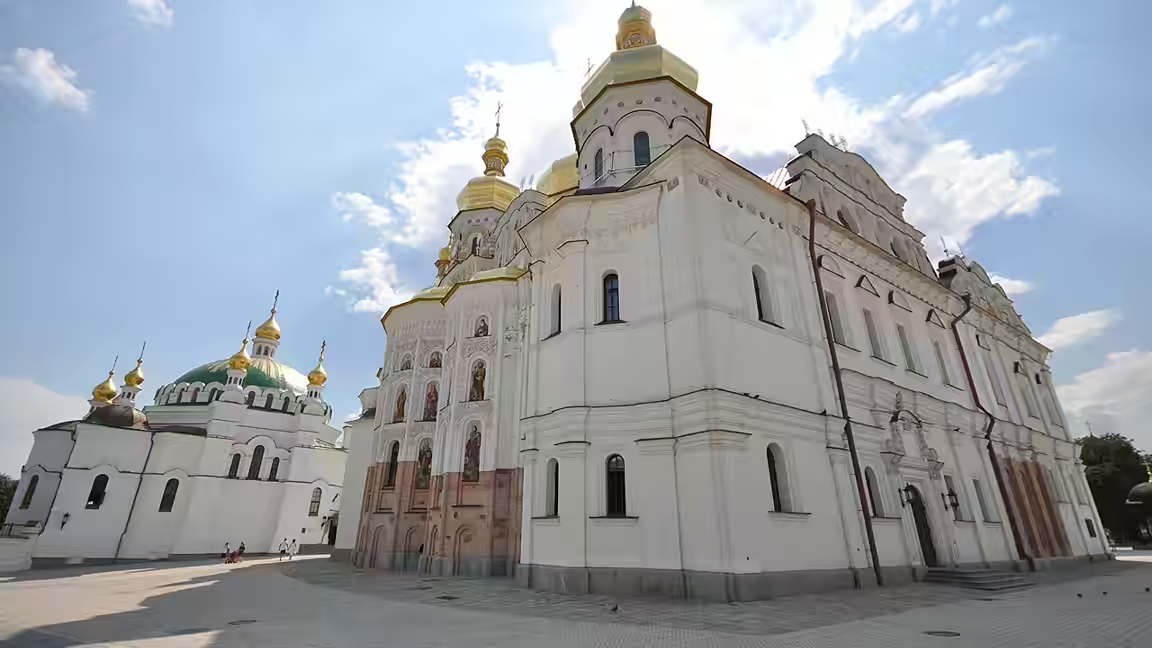
Other institutions were also damaged. Meduza reported blast-wave damage to the National Art Museum of Ukraine, which closed indefinitely, although its staff and collection were reported unharmed. The national philharmonic, the music academy, an opera and ballet theatre, universities, libraries and religious buildings were among the affected sites. The available reporting did not specify the extent of damage at every location.
European leaders condemned the attack and the reported Oreshnik deployment. Yet the immediate significance lay in the combined human and cultural loss: four deaths across Kyiv and its region, dozens of injured residents and damage extending from apartment blocks and water infrastructure to institutions preserving Ukrainian history. Casualty totals and technical assessments remained preliminary as emergency crews continued their work.


