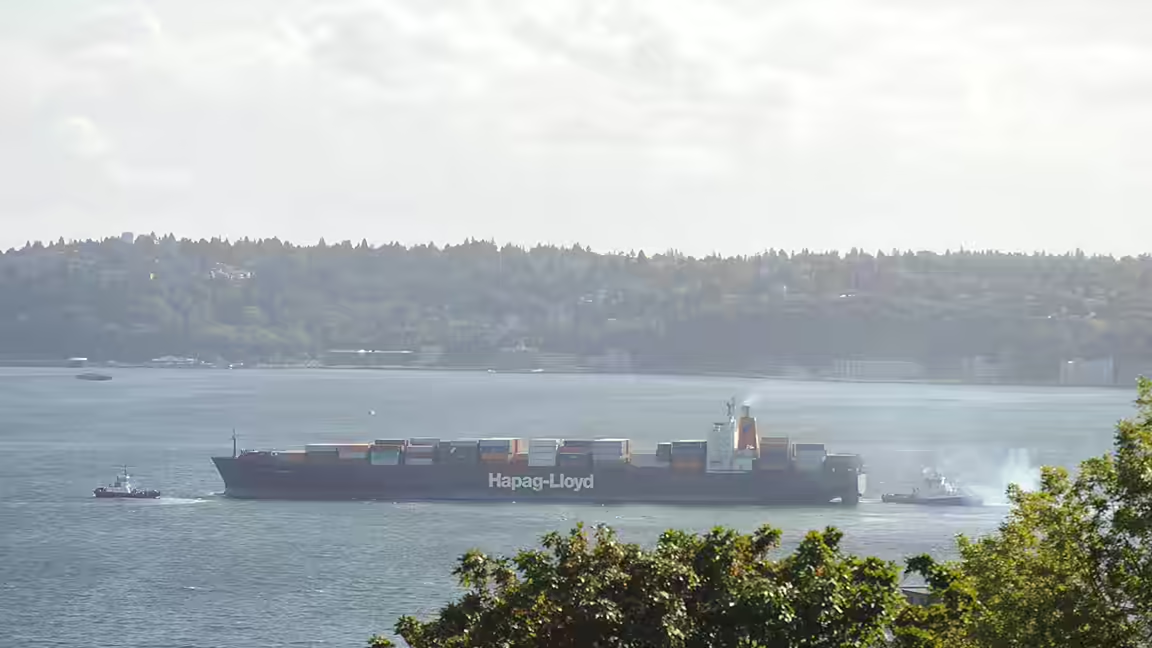
Commercial traffic around the Red Sea faced a fresh warning after Yemen's Ansar Allah movement announced a maritime embargo directed at Saudi Arabia. The Houthi group said its declaration took effect at once, although neither Al Jazeera nor CNBC described an actual interdiction resulting from it.
How the policy would operate remained unspecified. No list of targeted ships, enforcement zone or navigation instructions accompanied the material available for this report. It was likewise uncertain whether the announcement meant Houthi attacks on international vessels near Yemen would restart. A declared blockade and a functioning closure are not equivalent, so its practical impact had yet to be demonstrated.
The movement portrayed its action as reciprocal punishment for what it alleged was a Saudi siege lasting almost 12 years. That accusation was a Houthi characterization. Its leaders also urged supporters to mobilize and threatened a strong answer to further Saudi moves.
Events at Sanaa International Airport formed the immediate backdrop. Ansar Allah accused Saudi Arabia of attacking the facility. Yemen's internationally recognized authorities instead said their forces conducted the operation to prevent an Iranian aircraft from arriving. The supplied accounts do not determine which narrative is correct. Ansar Allah then fired ballistic missiles in the direction of Abha's airport. Saudi coalition officials reported successful interceptions.
Geography makes the warning economically important. Bab al-Mandeb links the Gulf of Aden and Red Sea, narrowing to 29 kilometers, or 18 miles. During 2024, approximately 4.1 billion barrels of petroleum and refined fuels crossed that passage, representing around five percent of worldwide volume. Kpler figures cited in the reporting placed June traffic at 7.4 million barrels daily, versus 4.2 million during the previous year.
Saudi export adjustments added to the stakes. The 1,201-kilometer Petroline carries crude westward from Abqaiq to Yanbu and has capacity near seven million barrels each day. Recent Yanbu loadings averaged four million barrels daily, ship-tracking figures cited by Reuters showed. A year earlier, the comparable level was roughly 973,000.
Ansar Allah had previously disrupted maritime commerce near Bab al-Mandeb following the start of the Gaza conflict in 2023. Those attacks ceased when a Gaza ceasefire was announced the next October. Renewed enforcement could therefore affect energy routes, but the evidence supported only a threat at this stage. It did not show a closed waterway, seized vessel or measurable interruption caused by the new declaration.
At the event date, the available record did not resolve those outstanding questions. Subsequent independent documentation would be necessary before disputed descriptions could be stated without qualification.
Maritime operators would need concrete enforcement details to judge exposure beyond the general warning. None appeared in the reports.


