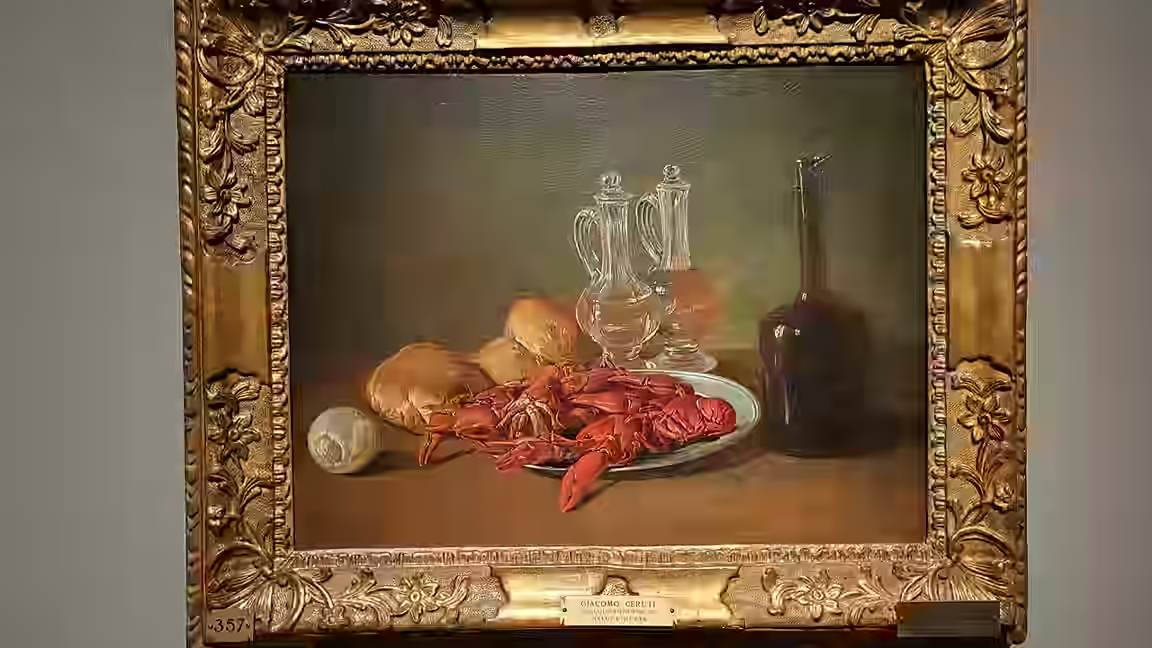
An Argentine judge has ordered the return of an 18th-century painting taken by Nazis from Dutch Jewish art dealer Jacques Goudstikker, closing a legal chapter that began when the work was spotted in photographs of a home for sale in Mar del Plata.
The painting, Portrait of a Lady, was identified last year in images of the seaside property, where it had been hanging above a green sofa in the living room of Patricia Kadgien. Her father, Friedrich Kadgien, was a financier for the Nazi SS and one of several high-ranking figures who fled to Argentina after World War II. The painting had been missing for about 80 years, and its appearance in a real-estate listing transformed an obscure wartime loss into a live restitution case.
On the event date, judge Santiago Inchausti said an order would be issued to return the work to Goudstikker's heir, Marei von Saher. The agreement was reached between the involved parties, and the report says the painting is now in the custody of Argentina's Supreme Court while von Saher's legal team begins the process of recovering it.
The provenance of the painting places it firmly inside the broader story of Nazi art theft. Goudstikker's collection included more than 1,000 artworks seized after the German invasion of the Netherlands in 1940. He fled the country soon after the invasion, leaving behind a collection that was later divided up by senior German officials. After the war, the Dutch state recovered roughly 300 items from the collection, and most of those were eventually returned to Goudstikker's heirs. This work, however, remained missing until the Argentine discovery.
The case has also brought criminal consequences. According to the report, Patricia Kadgien and her husband were charged with concealment and placed under house arrest once the painting was identified. In court, Kadgien held a rosary. The pair later agreed to hand over the work and to pay about $3,200 to local hospitals. Federal prosecutor Carlos Martinez said the individuals under investigation had effectively renounced any rights to the painting.
The work itself has also been examined. Martinez said it was in good condition and had been confirmed as authentic by expert review. That matters because restitution claims depend not only on the moral weight of wartime theft but also on whether the object recovered is in fact the object at issue. In this case, the identification appears to have been strong enough to carry the dispute from discovery into formal return.
Von Saher, who is Goudstikker's daughter-in-law and sole heir, wants the painting exhibited in Argentina for at least a year. Her lawyer said talks are under way with museums to make that possible. If that happens, the painting would become more than a reclaimed object. It would also serve as a public marker of the collector's story, a reminder of how many works were stolen during the Nazi era and how long some of them remain hidden in plain sight.
For Argentina, the decision turns an accidental discovery into a restitution outcome. For the Goudstikker family, it means a missing work can finally be linked back to its history after decades in the dark.