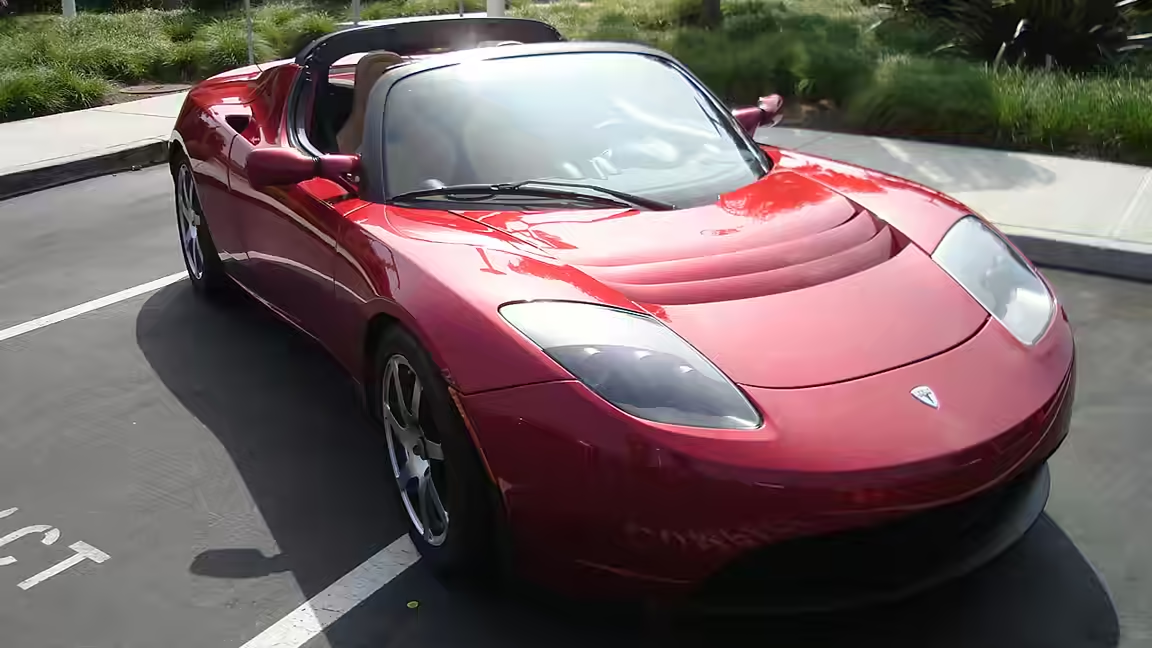
Tesla has demonstrated a redesigned Roadster equipped with cold-gas thrusters, using the long-delayed electric sports car to perform airborne maneuvers at a SpaceX test site in McGregor, Texas. Company executives said production is now planned for 2028, eight years after the delivery target attached to the prototype shown in 2017.
During the Oct. 15 presentation, the Roadster accelerated along a curved ramp and used a fan-based suction system to remain attached as the track turned upside down. The vehicle then used integrated thrusters developed with SpaceX to leave the ramp, rotate in the air and land. A separate demonstration sent the car over a line of vehicles, including a semi-truck.
Tesla also showed the Roadster accelerating from zero to 60 miles per hour in less than one second. Chief executive Elon Musk said some versions would exceed 230 mph. Tesla attributed the acceleration to a thruster system that, according to the company, can generate four to five times the force available through tire grip alone. Those performance figures were presented by Tesla at the event and have not yet been established through independent production-vehicle testing.
The demonstration placed unusual emphasis on features derived from aerospace engineering. Cold-gas thrusters produce force by releasing stored compressed gas, allowing the vehicle to add thrust beyond what its driven wheels can transfer to the road. Tesla used that system as the centerpiece of a launch intended to distinguish the Roadster from conventional high-performance electric cars.
Pricing was not formally announced on stage. Tesla's reservation page subsequently listed a $50,000 payment for a Performance version and a $250,000 payment for a Thrust version with acceleration thrusters. The company also described an invitation-only, single-seat Rocket variant with what it called a full flight system. A reservation payment is not necessarily the final vehicle price. Tesla had quoted a $200,000 base price when it first revealed the next-generation concept nearly a decade ago.
The revised production date underscores the gap between Tesla's original timetable and the current plan. When the prototype appeared in 2017, deliveries were expected in 2020. The company is now asking prospective customers to wait until 2028, assuming the latest schedule holds.
For Tesla, the Texas event established that a working demonstration vehicle can combine electric propulsion, suction and thrusters in a controlled stunt. It did not establish how those systems will be certified for ordinary roads, what the final specifications will be, or when customer vehicles will undergo independent performance tests. The next milestone is therefore not another demonstration but converting the technology into a manufacturable, road-legal product on the revised timetable.